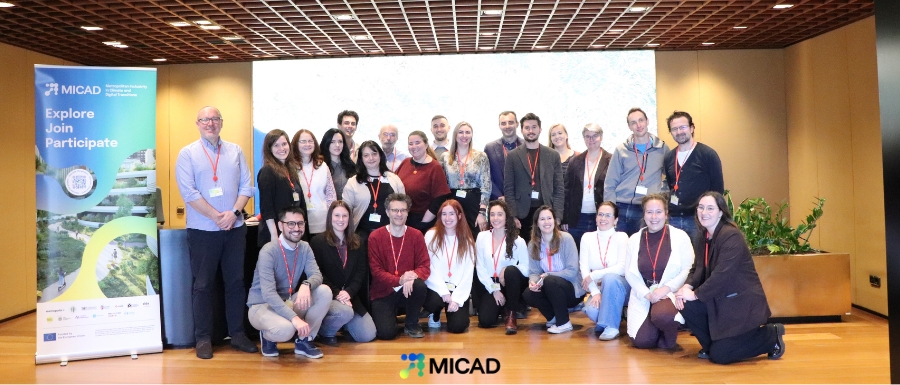
From 18 to 20 February, ALDA took part in the General Assembly of the Horizon Europe project MICAD – Metropolitan Inclusivity in Climate and Digital Transitions in Barcelona, Spain. The meeting brought together project partners to reflect on the first year of implementation and to plan the next steps.
The MICAD consortium gathers experts in urban planning, green and digital transitions, participatory processes, and living lab methodologies, including metropolitan authorities, universities, research institutes, and innovation networks.
Representing ALDA, Rebecca Marconi, Project Manager of MICAD, and Margherita Ferri, Project Assistant, participated in the meeting.
The General Assembly provided an opportunity to jointly review the results achieved during the first year of activities. In 2025, the project focused on building a solid research foundation to support inclusive climate and digital transitions in metropolitan areas. This included assessing the readiness of five European pilot metropolitan areas — Barcelona, Milan, GZM, Tirana, and Chișinău — to lead these transitions; identifying structural barriers to inclusive metropolitan governance; and developing a holistic framework linking climate action and digital transformation. The work also benefited from exchanges with 16 metropolitan areas from Latin America and Africa, bringing valuable Global South perspectives into the project.
The meeting then focused on testing the first prototype of the Toolkit for Inclusive Metropolitan Planning and launching the design phase of metropolitan climate and digital transition roadmaps. In addition, a series of interactive sessions on Living Labs, capacity building, and stakeholder engagement enabled partners to exchange ideas on how to foster fair and inclusive transitions within metropolitan contexts.
Within this framework, ALDA played an active role, contributing to the facilitation of several workshops, particularly by supporting metropolitan areas in identifying key stakeholders and testing the Toolkit.
Furthermore, Rebecca Marconi presented the project’s Exploitation Path and, together with METROPOLIS, facilitated a communication workshop to ensure coherence and effectiveness across partners’ outreach activities.
The final day featured roundtable sessions open to stakeholders from the Metropolitan Area of Barcelona. Rebecca Marconi contributed to the roundtable “Building the Digital Metropolis”, which explored how the digital transition can both strengthen and challenge democratic systems, and how citizens can actively shape this process at the metropolitan level. The session gathered MICAD partners alongside officials and representatives from various municipal departments, who discussed the opportunities and challenges of digital transformation in metropolitan governance. The debate addressed key issues such as the use of AI-supported decision-making in urban management, the safeguards needed to ensure transparency and accountability, and the role of digital tools in enhancing democratic participation. Participants also reflected on what a successful metropolitan digital transition could look like in the coming decade — one that promotes inclusivity and ensures that no one is left behind.
Beyond the inspiring discussions on digital and climate transitions, the programme also offered the opportunity to observe concrete examples of innovation through field visits to the Barcelona Supercomputing Center and to climate shelters in L’Hospitalet de Llobregat. These visits showcased local approaches that translate ideas into action and contribute to metropolitan planning for the wellbeing of communities.