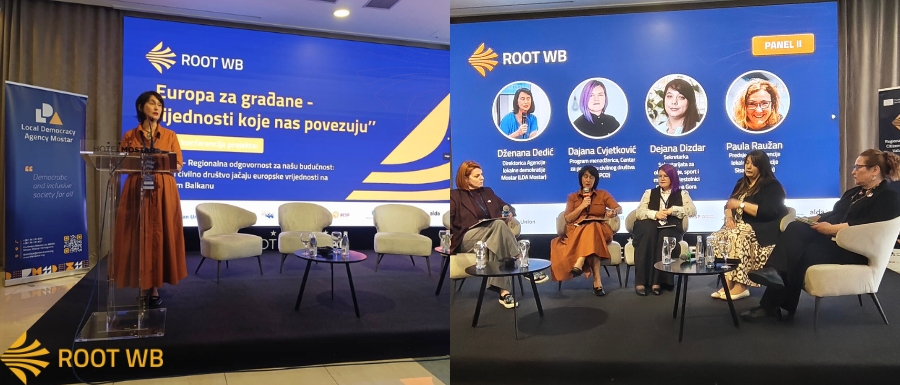
On 12 March, the city of Mostar, Bosnia and Herzegovina, hosted the kick-off conference of the project Regional Ownership of Our Tomorrow: Citizens and Civil Society Growing EU Values in the Western Balkans (ROOT WB), marking the beginning of a regional initiative aimed at strengthening civic engagement and promoting European values.
Famously described by Nobel laureate Ivo Andrić as a “city of light”, Mostar provided a symbolic setting for the launch of this project, funded by the European Union under the CERV programme. ROOT WB seeks to reinforce democratic participation across the Western Balkans by fostering dialogue, collaboration, and active civic involvement.
The conference brought together partners and stakeholders from Bosnia and Herzegovina, Albania, Croatia, Montenegro, North Macedonia, Serbia, and France under the slogan “Europe for Citizens – Values that Connect Us.” The event emphasised the transformation of citizens from passive observers into active architects of democratic processes, while highlighting the importance of cooperation between public authorities and civil society.
Representatives from several partner organisations participated in the event, including the Network of Associations of South East Europe (NALAS), the Centre for Democracy and Human Rights (CEDEM), ACT Centre, the Belgrade Centre for Security Policy (BCSP), LDA Sisak, the European Movement of North Macedonia (EMMK), and ALDA.
The conference opened with welcoming remarks by Ms. Dženana Dedić, Director of LDA Mostar; Ms. Nihada Butković, Senior Advisor for Civil Society Development at the Ministry of Justice of Bosnia and Herzegovina; and Mr. Miroslav Landeka, representative of the City of Mostar. Their speeches underscored the importance of civic participation and regional cooperation in advancing democratic values.
This was followed by a presentation from Ms. Jelena Krešić, ROOT WB Project Coordinator at LDA Mostar, who outlined the project’s vision, objectives, and regional relevance. Her intervention highlighted the importance of making European values tangible at the local level and strengthening democratic engagement across communities.
Two panel discussions provided deeper insights into both the challenges and opportunities facing the region.
The first panel, “Facing the Challenges of Regional Cooperation in the Western Balkans”, featured contributions from representatives of local authorities and civil society, who discussed the role of cooperation in rebuilding trust and advancing EU integration processes at the local level.
The second panel, “Civic Engagement in Practice and Local Impact”, focused on concrete examples of citizen participation and collaboration between institutions and civil society organisations. Speakers shared experiences related to the protection of civic rights, youth engagement, and successful local initiatives that demonstrate the impact of inclusive governance.
The programme continued with three interactive World Café sessions, designed to encourage dialogue and exchange among participants. These sessions addressed key topics such as youth and women’s engagement in democratic processes, the protection of civic space and citizens’ rights, and the importance of cross-border cooperation in promoting European values in practice.
Through these exchanges, participants gained practical insights into how to strengthen civic engagement and ensure that democratic values are embedded in everyday governance processes.
The conference concluded with a cultural activity entitled “Roads of Invisible Mostar Women”, a walking tour that highlighted the often-overlooked role of women in the city’s history. This experience provided a meaningful local perspective on resilience, inclusion, and empowerment, reinforcing the broader themes of the ROOT WB project.
The launch of ROOT WB marks an important step towards fostering active citizenship, strengthening civil society, and promoting shared European values across the Western Balkans.