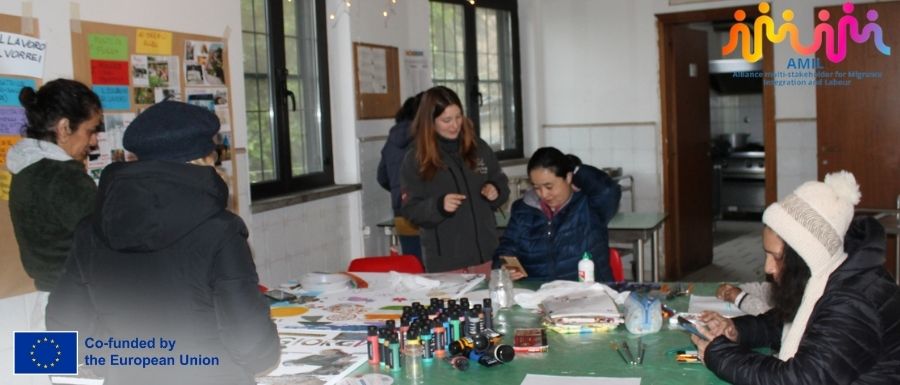
In March, at Casa di Giorgia – a center that welcomes migrant women, either alone or with children – an 8-session training cycle was held focused on labour market integration.
The activity was implemented within the framework of AMIL – Alliance Multi-stakeholders for Migrants Integration and Labour, the project that promotes sustainable integration pathways for third-country nationals through the MEIC methodology (Migrants Economic Integration Cluster).
CIES Onlus, the lead partner of the project, presents below the features and implementation methods of this pathway.
The training programme, completely free of charge, is aimed at strengthening the employability of migrant women through activities and creative workshops. To facilitate participation, the AMIL project chose to carry out the activities directly within the centre, responding to the needs of the beneficiaries.
The pathway was structured into three main areas:
- An employability workshop dedicated to exploring the essential tools for entering the labour market in Italy.
- A personal empowerment pathway, aimed at self-awareness, the recognition of strengths and areas for improvement, and the definition of strategies to achieve personal goals.
- An artistic-expressive workshop, designed to develop soft skills that are valuable in the professional sphere.
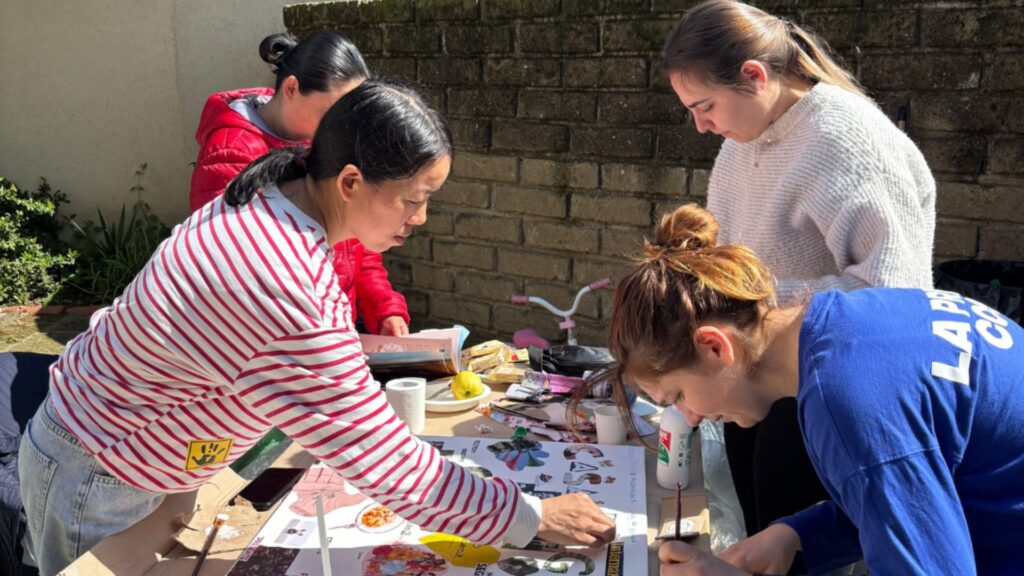
This last workshop transformed the space into an environment of expression, connection, and shared imagination. Through simple tools such as painting and decoupage, it was possible to create an accessible setting even in the presence of language barriers, allowing participants to express themselves without the need for words. Visual language made it possible to share complex experiences, encouraging the emergence of emotions and spontaneous dialogue among participants.
The pathway accompanied women from diverse backgrounds and countries – including China, Brazil, Pakistan, Cuba, and several African countries – in a progressive narrative journey that passed through personal roots, lived experiences in the present, and aspirations for the future.
All workshops were conducted using an interactive and non-formal approach, which made it possible to overcome language barriers and foster active and inclusive participation. The deepest value of the experience emerged in its relational dimension. A strong capacity for mutual care developed, expressed through spontaneous gestures of welcome and attention, transforming the workshops into an authentic space of human and social exchange.
Final Thoughts
The experience confirms how, in reception and integration pathways, the connection between people, empowerment, and the construction of future perspectives are central. In particular, it highlights the fundamental role of non-formal education and interaction as tools to overcome linguistic and cultural barriers. It also represented also a valuable exchange for trainers and operators of the centre, offering the opportunity to closely observe the daily dynamics of the reception context and training activities.