Restorative Outreach for Youth and Territorial Engagement
Montebelluna – Last Tuesday, experts from Italy, Finland, and Ireland gathered to present the outcomes of 18 months of transnational cooperation aimed at transforming conflict into opportunities for youth inclusion.
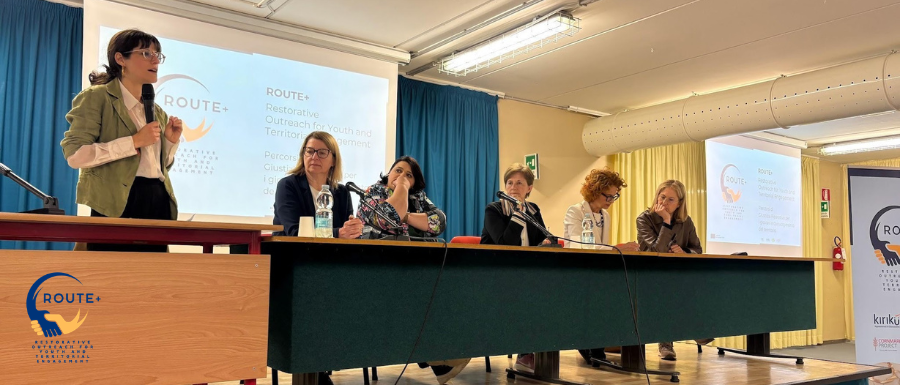
The final event of the project ROUTE+ (Restorative Outreach for Youth and Territorial Engagement) took place at the “Einaudi Scarpa” Higher Education Institute (Luigi Einaudi ITS Campus). Co-funded by the European Union, the initiative brought together partners from Italy, Finland, Ireland, and France to strengthen restorative approaches within educational, judicial, and community contexts.
After a year and a half of collaboration, the partnership presented the main milestones achieved throughout the project.
ROUTE+ aimed to strengthen the capacities of educators and public actors while promoting an educational culture based on dialogue, relationship-building, and harm repair.
Restorative practices were explored through different national perspectives. The Finnish partners focused primarily on the educational system, while the Irish experience addressed the judicial dimension more directly. The Italian partners, on the other hand, concentrated on the role of local communities and territorial support systems.
During the morning session, participants presented the main outputs developed within ROUTE+, including training programmes adapted to different national contexts and the publication of an e-Toolkit. Combining theoretical approaches with practical experiences, the toolkit aims to encourage the wider adoption of restorative tools within local communities.
Speeches and Speakers
The event welcomed prominent experts from the fields of education and restorative justice, who shared their experiences and technical insights. Opening the session and the subsequent stakeholder discussion was Tim Chapman, international expert, former President of the European Forum for Restorative Justice until 2022, and lecturer at Ulster University.
Chapman remains a key figure in the field thanks to his contribution to the implementation of restorative justice practices in Northern Ireland, demonstrating how these approaches can be effective even in contexts marked by violence and social division. He also contributed to drafting the Council of Europe’s guidelines on restorative justice in criminal matters.
The event continued with presentations from representatives of each pilot country and concluded with a round table discussion involving local stakeholders, focusing on the future development of restorative practices in the region.
Today’s event does not simply mark the end of a technical journey,” the partners emphasised, “but rather celebrates a more human vision of justice — one capable of turning conflict into an opportunity for collective growth and stronger communities.