The European Union remains the most desired option among Macedonian citizens. As many as 65.7 per cent believe the EU is the best alternative, while fewer than one third think that North Macedonia should pursue its own development model outside the Union. The majority of citizens believe that North Macedonia will never become part of the European family. Among those who are optimistic, 23.3 per cent expect this to happen within the next five years, while around 30 per cent believe it will occur within the next five to fourteen years. Over the past three years, the share of citizens who believe that North Macedonia will join the EU within five years has risen from 10.2 to 23.3 per cent.
However, the survey also reveals a contradiction. Although citizens are optimistic that Macedonia could join the Union within the next five years, perceptions are growing that the EU’s attitude towards Macedonia is unfair, arrogant, and coercive.
As for democracy, public opinion has improved.
In just three years, the proportion of citizens who believe there is no democracy in Macedonia has fallen from 56 per cent to 39 per cent. Nevertheless, only a small share consider that the country is moving in the right direction.
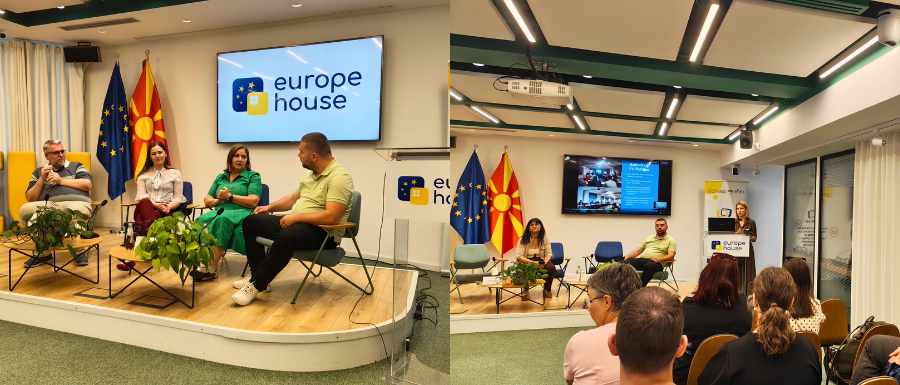
These are only part of the findings from the national Eurometer survey for 2026, conducted by Eurothink – Centre for European Strategies and presented at the final event of the #Media4EU project, which was held on June 19 in Europe House Skopje, implemented by Eurothink in partnership with ALDA and BIRC, with support from the European Union. The newest survey was compared with the findings from the Eurometer survey conducted in 2023.
The findings were presented by Dimitar Nikolovski, Executive Director of Eurothink, while the project achievements were presented by Katica Janeva, Executive Director of ALDA Balkans.
The Mentorship Programme achieved significant impact, with eight young journalists trained through two rounds and 162 media products published on Eurothink and BIRC platforms. This work increased the visibility of EU accession topics among younger audiences, strengthened cooperation between senior and junior journalists, and enhanced practical reporting skills on EU policies and reforms.
Meanwhile, the School of EU Politics was implemented in two editions, in Veles and Skopje, attracting 40 applicants in total and engaging 34 participants. The programme focused on EU institutions, policies, and negotiation chapters, with contributions from experts and practitioners across the media and civil society sectors.
The event concluded with a panel discussion, Professional Journalism in the Age of Algorithms, moderated by Lorik Idrizi, Project Manager at BIRC. Contributions were made by Sefer Tahiri, University Professor and Media Expert,Vanja Micevska, journalist at TV Telma, and Biljana Georgievska, representative of the Council of Media Ethics of Macedonia [CMEM].