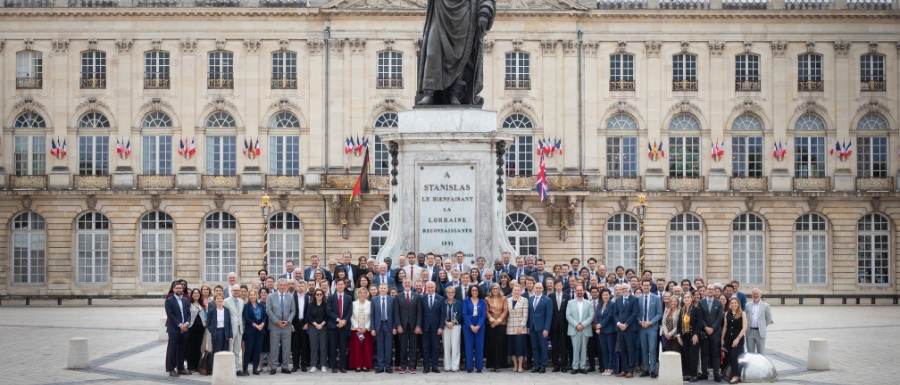
On 3-4 June 2026, ALDA’s Secretary General, Antonella Valmorbida, and ALDA France network & Partnership Expert, Denys Tkachov, participated in the Urban7 (U7) International Mayors Summit in Nancy (France), alongside more than 200 mayors, local elected representatives, and civic leaders from fifteen countries worldwide.
Organised by France urbaine, ICLEI – Local Governments for Sustainability, the Global Parliament of Mayors, the City of Nancy and the Greater Nancy Metropolitan Authority under the French G7 Presidency, the Summit took place just days before the G7 Leaders’ Summit in Évian-les-Bains. Bringing together representatives from G7 countries as well as delegations from Brazil, India, Kenya, South Korea, and Ukraine, the event focused on strengthening the contribution of cities and local governments to addressing the major challenges facing democratic societies today.
A key outcome of the Summit was the formal recognition of Urban7 as an official engagement group within the G7 process, creating a structured channel through which local governments can contribute to international policymaking and advocate for stronger multilevel governance.
Held under the theme “Resilient Cities, Resilient Democracies”, the Summit highlighted the increasingly strategic role of cities in responding to global challenges. From climate change and social inequalities to geopolitical instability, digital transformation, and democratic backsliding, local governments are often the first institutions called upon to provide concrete solutions and maintain public trust.
As part of the programme, Antonella Valmorbida contributed to a workshop on democratic resilience, highlighting the increasingly important role of local governance in safeguarding democratic societies in an era marked by geopolitical tensions, disinformation, political polarisation, and declining civic participation.
Drawing on ALDA’s more than 25 years of experience promoting local democracy, she emphasised that local governments often represent the most trusted level of governance and remain essential actors in preserving social cohesion, democratic stability, and public trust. Through its network of Local Democracy Agencies, ALDA has witnessed first-hand how strong local institutions and active citizen participation can strengthen communities facing political instability, post-conflict recovery, and external pressures.
Particular attention was dedicated to Ukraine, where local authorities have demonstrated remarkable resilience since the beginning of the full-scale invasion. As highlighted during the discussion, municipalities played a crucial role in coordinating humanitarian responses, maintaining essential services, and supporting their communities, proving that decentralised governance is not only a matter of administrative efficiency but also a cornerstone of democratic resilience.
ALDA Secretary General also stressed the importance of rebuilding trust through meaningful citizen engagement. Moving beyond traditional consultation mechanisms, she advocated for more structured participatory approaches, including citizens’ assemblies, participatory budgeting, and long-term cooperation between local authorities, civil society organisations, and community actors. According to her, resilient democracies are built when citizens are not merely consulted but actively involved in shaping public decisions.
Looking ahead, she called for a transition from “Smart Cities” to “Wise Cities”, where technological innovation and artificial intelligence are used not only to improve public services but also to strengthen participation, transparency, and democratic accountability. While digital tools can offer new opportunities for engagement, they must be accompanied by safeguards capable of countering disinformation, manipulation, and growing digital polarisation.
Her intervention concluded with a clear message: local governments should be recognised not merely as service providers, but as key partners in building democratic resilience, security, and stability. Investing in local democracy and civil society, she argued, is one of the most effective ways to strengthen democratic societies and prevent democratic backsliding.
The summit featured a dedicated panel, “Supporting Ukrainian Cities: Urban Reconstruction And Resilience Strategies,” where leaders of Ukrainian communities discussed resilience, intermunicipal cooperation, and local democracy. Leveraging its extensive Ukrainian network, ALDA presented flagship projects like the Local Democracy Agencies alongside practical examples from the Bridges of Trust and Shoulder-to-Shoulder initiatives.
The Nancy Declaration
The Summit concluded on 4 June with the signing of the Nancy Declaration – Resilient Cities as the Foundation of Global Resilience, which will be presented to the French G7 Presidency ahead of the G7 Leaders’ Summit in Évian-les-Bains.
The Declaration calls on G7 governments to recognise cities as custodians of peace, democracy, and global solidarity, while strengthening their role in climate action, economic development, urban resilience, and international cooperation. It advocates for stronger multilevel governance, greater support for city diplomacy, and increased investment in local resilience strategies.
Particular attention is dedicated to supporting Ukraine’s recovery, reinforcing local democratic governance, strengthening city-to-city cooperation, and promoting resilient and sustainable urban development. The document also highlights the importance of affordable housing, climate adaptation, digital governance, and citizen-centred approaches to urban transformation.
As stated in the Declaration:
“The resilience of our cities ultimately rests on the human bonds that sustain them — the social cohesion of our communities, the sense of belonging shared across generations, and the universal access to quality public services that bind urban life together.”
The discussions in Nancy reinforced a message that has long been at the heart of ALDA’s mission: democracy is strongest when it is rooted in local communities.
As democratic systems face growing challenges across Europe and beyond, investing in local institutions, strengthening civil society, and creating meaningful opportunities for citizen participation are becoming essential components of resilience, security, and stability.
Through its participation in the Urban7 International Mayors Summit, ALDA reaffirmed its commitment to ensuring that local democracy remains at the centre of European and international policymaking, recognising local governments not simply as service providers, but as key actors in safeguarding democratic values and shaping a more resilient future for all.