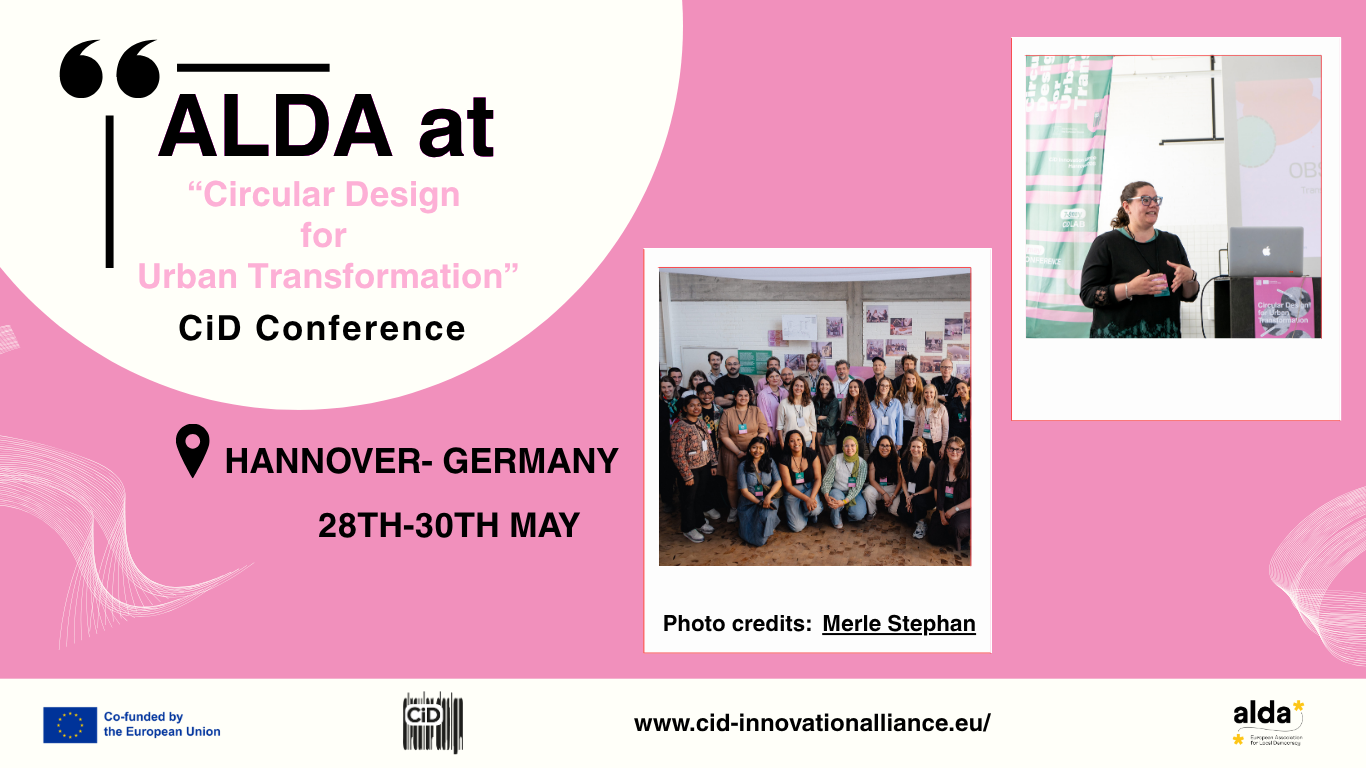
From 28 to 30 May 2026, the Circular Design (CiD) project of which ALDA is a proud partner, held the conference “Circular Design for Urban Transformation” in Hannover, Germany. Organised by the Leibniz University Hannover, the event brought together researchers, architects, designers, urban planners, and policymakers to explore how circular approaches can drive urban regeneration beyond consumption of resources and expansion.
By focusing on how long-term thinking in architecture and urban planning can contribute to more sustainable, resilient, and environmentally responsible urban development, the conference approached circularity as a key framework to rethink urban spaces, heritage, governance, and socio-economic processes. Special attention was given to the role of skills and the flow of knowledge between research, education, and professional practice, as well as to entrepreneurship and social innovation.
The conference programme was structured around three core thematic tracks: Circular Regeneration (focusing on urban space, communities, and nature), Circular Constellations (exploring actors, flows, and urban networks), and Circular Processes (addressing engagement, policies, and urban strategies). Alongside these main tracks, the programme featured key lectures, fishbowl discussions, a CiD LAB Hannover, and local site visits.
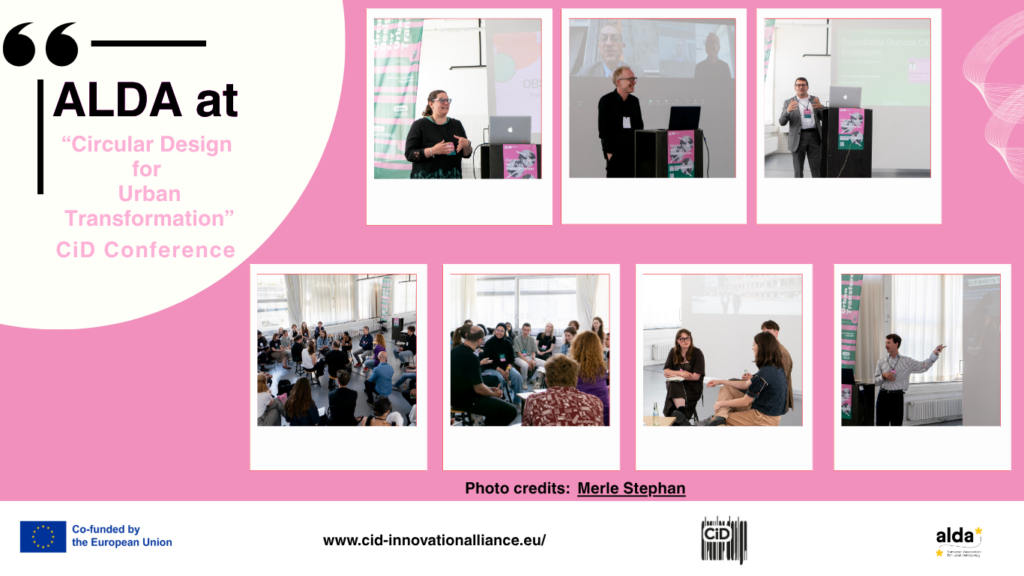
Roundtable Discussion: Impact and Outlook for the CiD Ecosystem
A major highlight of the event was the roundtable session “Outlook CiD Ecosystem,” held on Friday 29th of May. The panel brought together project partners to evaluate the transferability and future scaling of the project’s results. During the session, the University of Genova shared insights on implementing innovative academic courses, while Tallinn Business Incubator mapped out the role of the accelerator program. Additionally, ARCES addressed the necessity of continuous education to bridge professional skill gaps, and the Leibniz University of Hannover discussed the co-production of knowledge.
Eleonora Ambrosi represented the European Observatory of Urban Transformation coordinated by ALDA, the discussion addressed the long-term sustainability of the project’s foundational hubs. Given that these observatories are a distinctive feature of the CiD ecosystem, connecting the alliance directly to real-world needs, local stakeholders, and circular design experts, the exchange focused on the long-term outlook for these hubs after the project ends.. These discussions represented only a portion of the work carried out by the project. In particular, the project successfully connected more than 130 stakeholders through its observatory networks, demonstrating the strong interest in and relevance of Circular Design not only within education but also across a wide range of sectors.
Visit the website to find out more about the project.
Photo credits: Merle Stephan