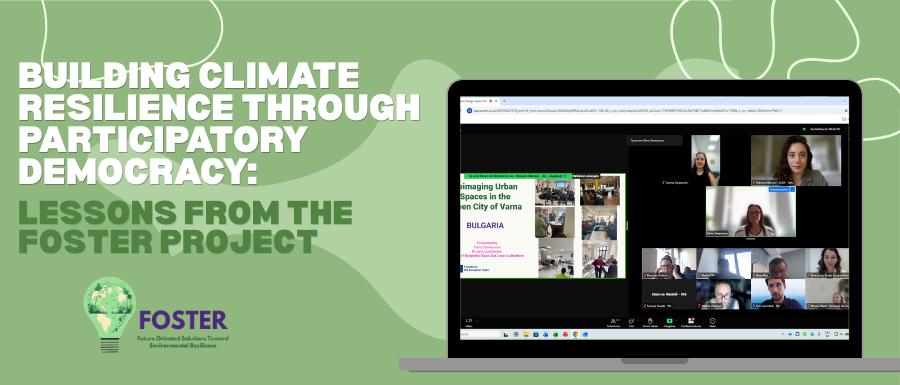
On 9 June 2026, the FOSTER project brought together policymakers, researchers, civil society organisations and citizens from across Europe for an international online conference dedicated to one of the most pressing challenges of our time: how can local communities strengthen their resilience to the long-term impacts of climate change through democratic participation?
Hosted by project partner Foster Europe, the event provided an opportunity to present the results achieved throughout the project while fostering a broader discussion on the role of participatory democracy, strategic foresight and collaborative governance in addressing climate-related challenges. Participants explored innovative approaches, exchanged experiences from different European contexts and reflected on the opportunities and obstacles communities face when planning for an uncertain future.
The conference opened with welcoming remarks from Stefan August-Lütgenau, Director of the Foster Europe Foundation, followed by an introduction to the FOSTER project delivered by Rebecca Marconi, Project Coordinator at ALDA. A keynote contribution by Tamara Ehs highlighted the conditions necessary for meaningful and effective citizen participation in climate policymaking, underlining the importance of long-term institutional commitment, permanent participatory mechanisms and supportive legal frameworks.
A central part of the event was dedicated to the presentation of the local pathways developed by the FOSTER partners: Association of Romanian Municipalities (Romania), Comparative Research Network (CRN, Germany), Foster Europe (Austria), IASIS (Greece), Istituto per la Ricerca Sociale (IRS, Italy), NOTUS (Spain) and the Union of Bulgarian Black Sea Local Authorities (UBBSLA, Bulgaria), with the support of the Council of European Municipalities and Regions (CEMR) and ALDA.
Through concrete case studies, partners shared how they engaged citizens and local stakeholders in envisioning future climate scenarios, identifying local vulnerabilities and co-designing practical adaptation and mitigation solutions tailored to their territories. The presentations demonstrated how strategic foresight can become a powerful tool for communities to anticipate future challenges and transform them into opportunities for collective action.
The discussion continued in two interactive breakout sessions, where participants had the opportunity to explore the case studies in greater depth, exchange perspectives and reflect on the lessons learned throughout the project. These conversations highlighted both the potential and the challenges of participatory climate governance, reaffirming the importance of creating spaces where citizens, experts and public authorities can jointly shape more resilient futures.
While each local pathway addressed specific territorial challenges, together they showcased how climate change is already affecting communities in different ways across Europe, from urban heat islands and flooding risks to pressures on sustainable housing, public spaces and both physical and mental wellbeing.
Despite the diversity of local contexts, several common challenges emerged from the case studies. Participants highlighted the increasing vulnerability of urban areas to extreme weather events, the unequal distribution of green infrastructure, the need to protect and regenerate public spaces, and the importance of ensuring that climate adaptation measures also address social inclusion and quality of life.
The FOSTER project demonstrates that climate resilience is not only a technical challenge, but also a democratic one, requiring active citizen participation and long-term collaborative governance.
The local pathways developed within the project showed how participatory foresight can help communities move beyond short-term responses and engage in long-term thinking. Through workshops, scenario-building exercises and co-design activities, citizens, civil society organisations and local authorities worked together to identify future risks and develop locally grounded solutions. These ranged from urban greening interventions and climate-resilient public spaces to sustainable housing strategies, stronger governance mechanisms and new forms of civic participation.
A recurring theme throughout the discussions was the importance of building trust between citizens and public institutions. Several partners reported that involving municipal representatives directly in the participatory process helped create constructive dialogue and increased the legitimacy of the proposed solutions. At the same time, participants recognised that maintaining engagement over time remains a challenge. Project partners highlighted the phenomenon of “participation fatigue”, particularly in contexts where citizens are repeatedly consulted without seeing tangible outcomes. Discussions confirmed that citizens are willing to engage in climate-related decision-making when they clearly understand the purpose of the process and when their contributions are translated into concrete actions.
Another key lesson emerging from the conference was that participatory processes alone are not sufficient. Long-term impact requires institutional commitment, supportive legal frameworks, coordination among stakeholders and mechanisms that ensure the implementation of collaboratively developed solutions. As several speakers noted, participation is most effective when it becomes an integral part of governance rather than an isolated project activity.
The conference also enriched the discussion through contributions from practitioners and civil society representatives working on climate governance in different European contexts.
Drawing on the experience of Moldova, Anatolie Risina (Verde e Moldova) reflected on the challenges of building climate resilience in a society undergoing multiple transitions simultaneously. In contexts characterised by uncertainty, democratic participation becomes a crucial resource. Climate change cannot be addressed in isolation from broader social, economic and geopolitical transformations. Local knowledge, social trust and citizen engagement are essential for strengthening resilience and ensuring the legitimacy of climate policies.
A complementary perspective was offered by Oleg Dyakov (Rewilding Ukraine), who explored the intersection between climate change, biodiversity conservation and the consequences of war in Ukraine. His presentation demonstrated how environmental resilience and social resilience are deeply interconnected. Through examples of ecosystem restoration, wetland recovery and community-based rewilding initiatives, he highlighted the role of local actors in responding to complex crises. The Ukrainian experience showed how participatory approaches can contribute not only to environmental recovery but also to community wellbeing, social inclusion and long-term adaptation in contexts affected by conflict.
Marinela Spahiu (URI Albania) presented lessons from the Climate Bridges Network, a regional initiative promoting climate governance through cooperation between municipalities, civil society organisations and citizens across the Western Balkans. Her contribution highlighted the importance of trust-building, multi-stakeholder collaboration and practical citizen engagement in translating climate ambitions into local action, generating tangible results for communities and fostering lasting cooperation between institutions and civil society.
Together, these contributions reinforced one of the key messages of the FOSTER project: addressing climate change requires governance models that combine long-term thinking, community participation and cross-sector collaboration. Whether dealing with environmental degradation, social transformation or conflict-related challenges, resilient communities are built through inclusive decision-making processes that empower citizens to actively shape their futures and co-create practical, sustainable and inclusive solutions.