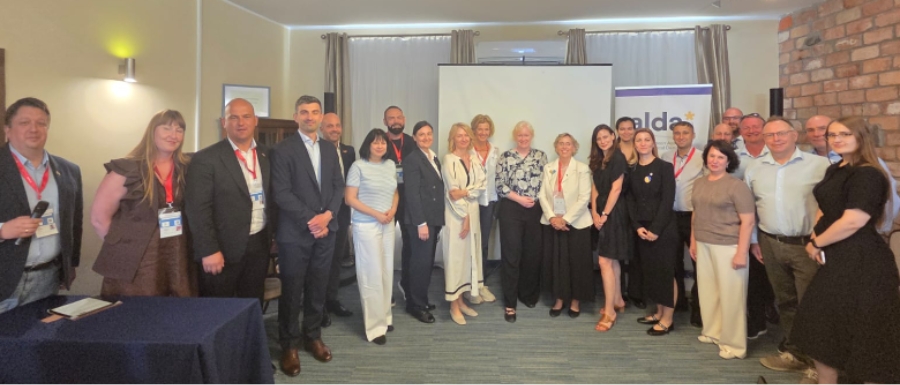
In the framework of the Ukraine Recovery Conference 2026 in Gdańsk, ALDA organised the side event “Local Democracy Agencies for Democratic Resilience and Recovery in Ukraine”, together with the Local Democracy Agencies and in collaboration with the Ministry for Development of Communities and Territories of Ukraine.
The event gathered more than 50 participants, including representatives of Ukrainian and European local authorities, civil society organisations, institutional partners and international stakeholders. It provided a high-level space to discuss the role of local democracy, territorial cooperation and participatory governance in Ukraine’s recovery and European integration process.
A concrete outcome of the event was the signing of three intermunicipal cooperation agreements, confirming the shared commitment to strengthen cooperation between Ukrainian communities and European partners. These agreements represent an important step in consolidating territorial partnerships and supporting locally owned recovery processes.
The discussion was moderated by Denys Tkachov, ALDA Expert, and opened with institutional remarks by Adrien Licha, Coordinator of the Secretariat and the Eastern Partnership Unit of ALDA. The opening framed local governance and democratic resilience as essential components of Ukraine’s reconstruction. As Ukraine moves from emergency response towards long-term recovery, the local level remains central to ensuring that reconstruction is not only efficient, but also inclusive, transparent and sustainable.
The keynote session, “From Emergency Response to Democratic Recovery: Why Local Democracy Matters”, focused on the transition from immediate support to long-term democratic resilience. In her intervention, Antonella Valmorbida, Secretary General of ALDA, underlined that sustainable recovery cannot be delivered to communities from the outside, but must be built with them and through them.
Drawing on ALDA’s long-standing experience in post-conflict contexts, including the Western Balkans, she recalled that physical reconstruction must go hand in hand with the rebuilding of civic trust, local capacities and democratic participation. In this perspective, local democracy is not a secondary element of recovery, but one of its foundations.
A central concept of the event was the methodology of embedded localism, which lies at the heart of the Local Democracy Agency model. Rather than relying on external, top-down approaches, LDAs operate through a permanent presence in local communities. This allows them to act as trusted platforms where local authorities, civil society and international partners can work together, identify real needs, co-design solutions and strengthen accountability.
This approach is particularly relevant in the context of large-scale reconstruction. Furthermore the panel discussion, “Leveraging the LDA Network for Reconstruction and Localised EU Integration”, addressed how the LDA network can help prevent the risks of top-down recovery models. Speakers discussed the importance of ensuring that reconstruction projects respond to actual community priorities, from housing and critical infrastructure to social cohesion, accessibility and public services. The discussion also explored the role of intermunicipal and interregional cooperation as a catalyst for Ukraine’s European integration. Participants highlighted that EU accession is not only a process negotiated at national level, but also one that must be implemented in municipalities.
In this framework, the panel addressed the relevance of EU Cluster 1 – the Fundamentals, with a focus on democracy, rule of law, public administration reform and civic engagement. The ALDA network was presented as a bridge between Ukrainian local authorities and European partners, supporting municipalities in strengthening their governance practices and aligning them with EU standards. A significant contribution was delivered by Tetiana Lomakina, Presidential Commissioner for Barrier-Free Environment, who expressed her gratitude to ALDA for their many years of support to local democracy in Ukraine. She underlined that, for many Ukrainian communities, Local Democracy Agencies have become more than partners: they have become spaces of trust, solidarity and joint problem-solving. She highlighted how Ukraine’s recovery is already happening now in every community hosting internally displaced people, in every local decision on housing, education, transport, accessibility and social services. For this reason, the development of local democracy is not a secondary task, but a key condition for successful recovery. In her moving remarks, Tetiana Lomakina paid tribute to the resilience of Mariupol and emphasised that a true recovery requires a shift toward “inclusive leadership based not only on authority, but on trust”. “Ukraine needs a culture where everyone has the opportunity to be heard, and where recovery begins with human dignity,“ she stated. The full speech is available here.
Another important theme was inclusive leadership as the event highlighted the need for a style of governance based not only on authority, but on trust, dialogue and shared decision-making. Inclusive leadership means listening to different voices: veterans, persons with disabilities, young people, internally displaced persons, older people and all those who are often less represented in decision-making processes. The quality of reconstruction will depend on the extent to which different experiences and needs are taken into account.
Through its network, ALDA will continue to support Ukrainian communities by promoting participation, strengthening cooperation with European partners and contributing to a culture of governance based on trust, responsibility and democratic ownership.
The side event in Gdańsk reaffirmed that Ukraine’s recovery must be locally driven, inclusive and democratic. It must rebuild what has been destroyed, but also strengthen the civic and institutional foundations of a fairer, more resilient and more united Ukraine.