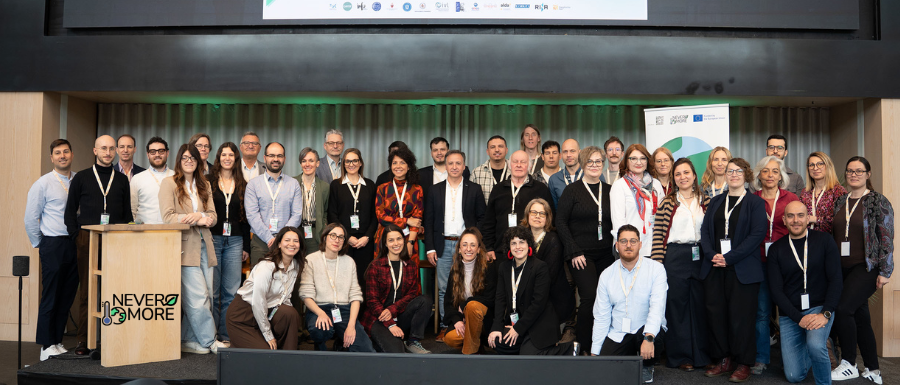
On 6 May 2026, the city of Luleå, Sweden, hosted the final event of the NEVERMORE project, a moment to reflect on four years of intensive collaboration and activities. The event, co-organised by ALDA, was held in a hybrid format to engage stakeholders across Europe and welcomed more than 300 participants, both online and in person.
Valeria Fantini, ALDA Project Manager, opened the event alongside the host, Lina Widenmo from Energikontor Norr, warmly welcoming participants. Following the opening remarks, Project Coordinator Alessia Torre from Fondazione Bruno Kessler (FBK) and Technical Lead Ivan Ramos from CARTIF Technology Center presented the core vision of NEVERMORE, highlighting how transnational collaboration and technical integration have been essential in translating complex climate science into concrete solutions.
The morning session, titled “Reading the Signs”, was led by Stelios Karozis from the National Center for Scientific Research Demokritos (NCSRD). He emphasised a key project principle: the challenge today is no longer simply collecting climate data, but localising it and transforming it into evidence-based policy decisions capable of generating tangible territorial impact.
This practical approach also guided the presentation of the advanced models developed by the consortium. Gonzalo Parrado from the University of Valladolid demonstrated the WILIAM Integrated Assessment Model and its ability to simulate complex interactions within food systems, while Sara Barilari from CARTIF explored the Local SD (System Dynamics) Model through analyses of crop sensitivity and water demand, showing how technology can support more resilient agricultural resource management.
Alongside physical modelling, the project developed digital solutions to strengthen the dialogue between science and policy. Sara Barilari and Chiara De Notaris from the Centro Euro-Mediterraneo sui Cambiamenti Climatici (CMCC) presented the ICT Toolkit, designed to bridge the gap between academic research and policy-making. Within the toolkit, instruments such as the Catalogue Explorer and the Case Study Tool provide practical support for decision-makers, while the Storylines presented by Chiara offer tailored scenarios to strengthen local adaptive capacity. The session also introduced the innovative Gamification Tool, aimed at raising awareness and fostering public engagement through interactive approaches.
The success of NEVERMORE, however, extends beyond technology and lies strongly in the power of participation. Eleonora Mencarini from FBK chaired a dedicated session on social impact and co-creation, showcasing the vital role of the project’s Local Councils. Throughout the project, these councils actively involved citizens, experts, and local decision-makers across five key European case studies: Sitia (Greece), Trentino (Italy), Norrbotten County (Sweden), Murcia (Spain), and the Danube Delta (Romania).
A powerful testimony to this participatory framework was shared by the Mayor of Aledo, Javier Andreo, who presented concrete examples of how local communities collaborated directly with researchers to shape the project’s outcomes.
The collaborative spirit of NEVERMORE was further highlighted during an afternoon panel featuring sister and mission projects such as DISTENDER, KNOWING, SPONGESCAPES, and PATHWAYS2RESILIENCE, all contributing to the broader EU Mission Adaptation framework and underscoring the importance of European synergies.
The event concluded with final reflections and closing remarks from Alessia Torre, who expressed sincere gratitude to all consortium partners, researchers, and local stakeholders for their dedication and commitment throughout the project.
The event proved highly participatory both online and in person, with several Q&A sessions moderated by Manal Snidi, ALDA Communication officer, promoting exchanges between researchers, policymakers, practitioners, and citizens.
The Luleå meeting does not mark the end of NEVERMORE, but rather the beginning of a new operational phase: from today, the project’s tools and resources are available to all those committed to building a more sustainable and climate-resilient future.
To explore the project’s results and access materials and MOOCs, please visit the official website of the NEVERMORE project.