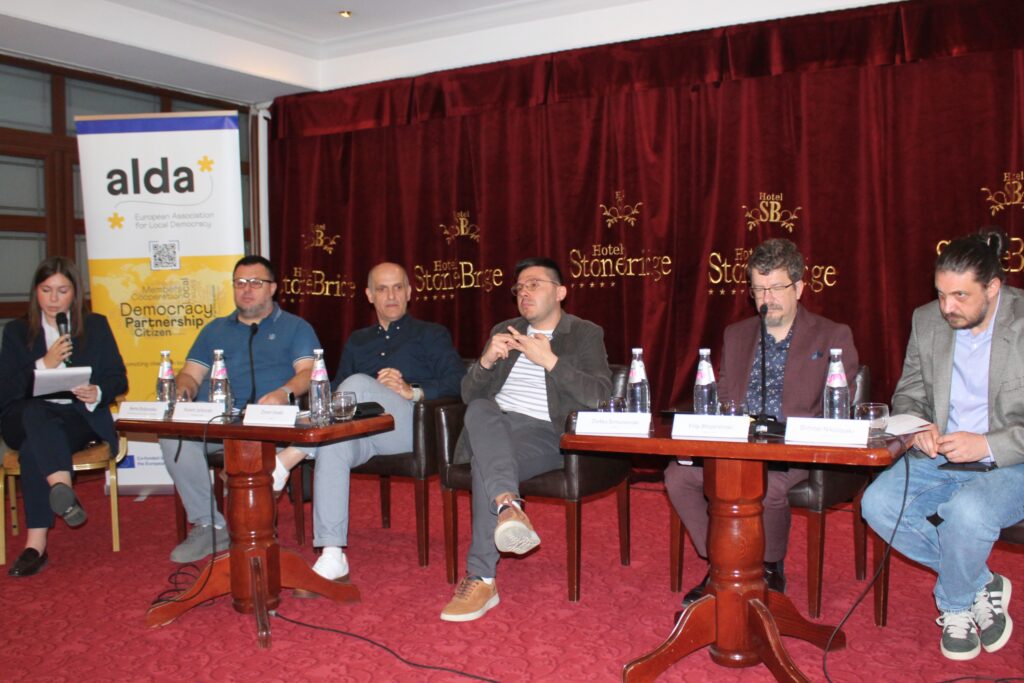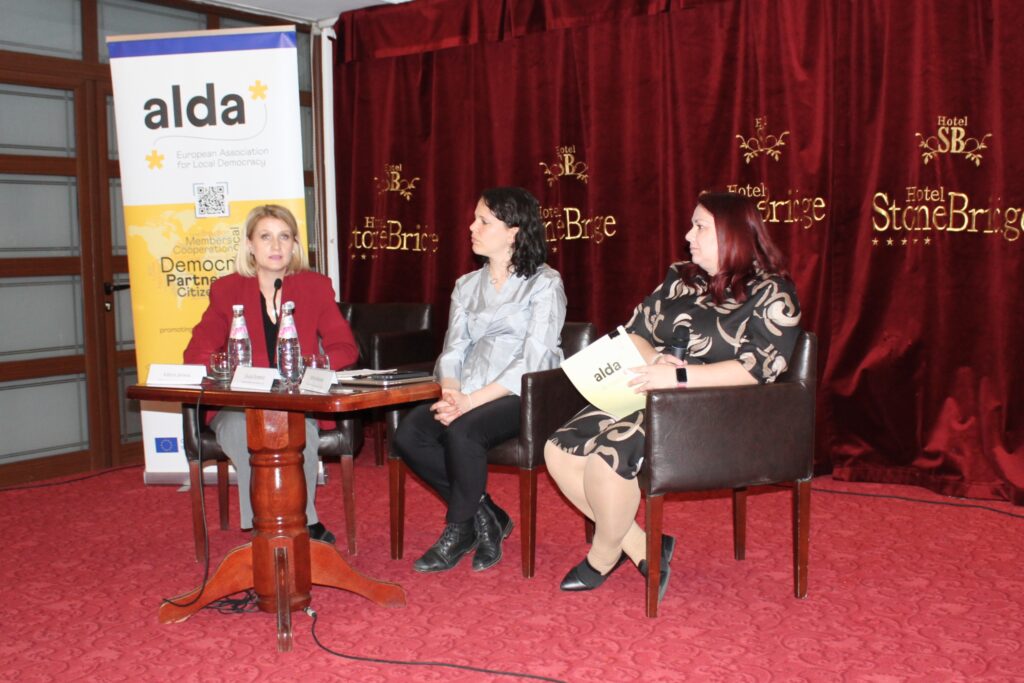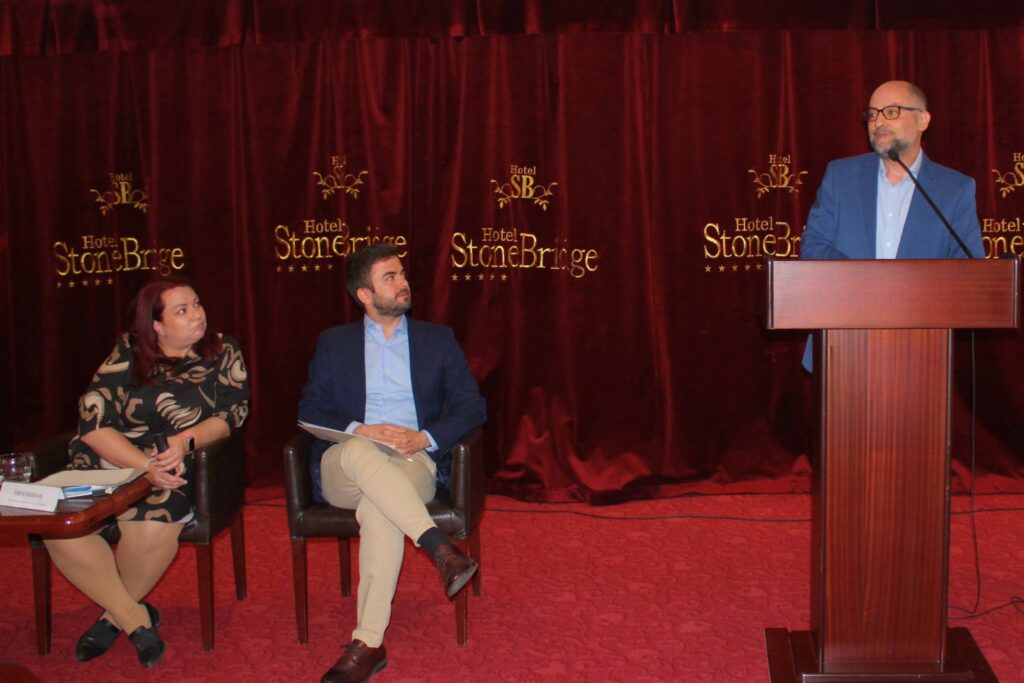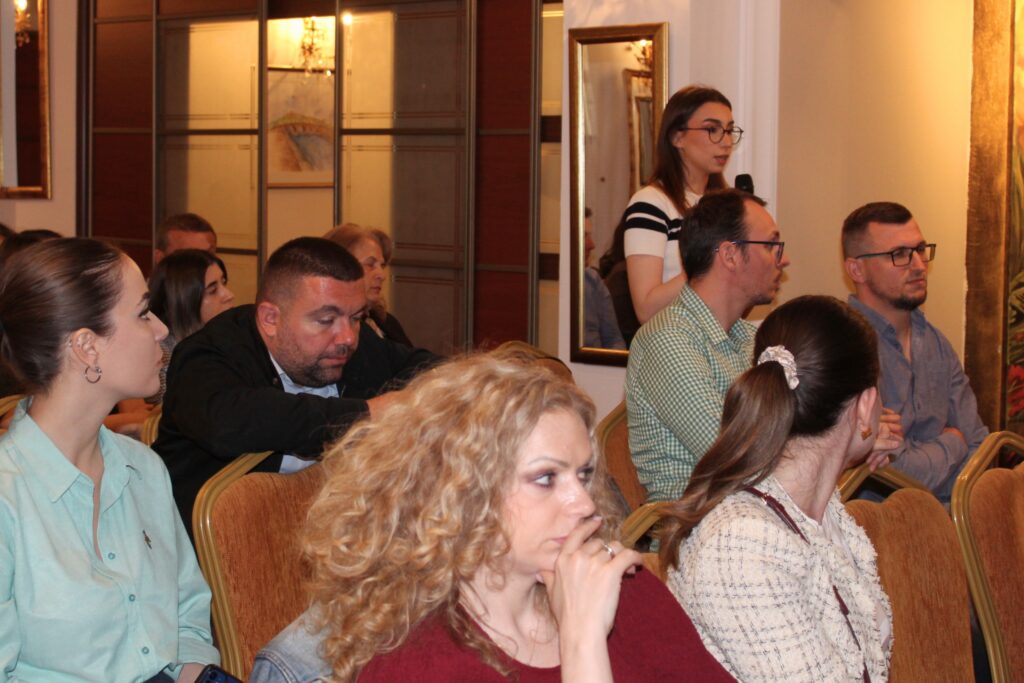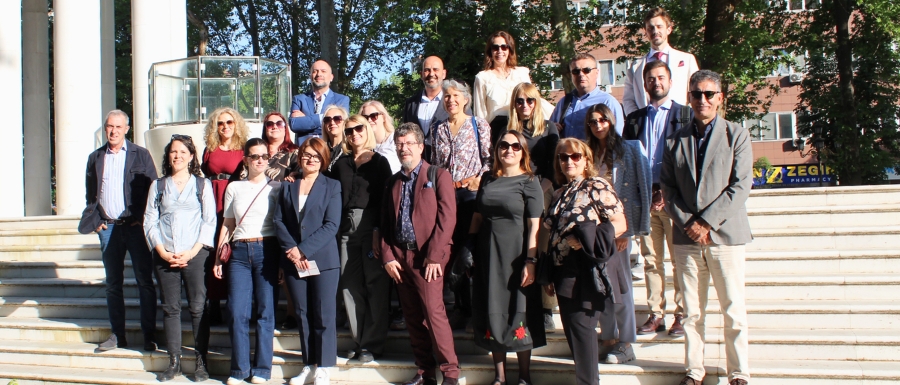
The city of layered histories, Skopje, became the destination of the ProVote initiative on 28 April, when the international event “Strengthening Local Democratic Resilience” examined how communities can reinforce democracy amid disinformation, declining trust, and reduced civic participation.
Organised under the ProVote framework and supported by the European Union under the CERV Programme, the conference, facilitated by ALDA Balkans, brought together local authorities, civil society organisations, and international partners. Through interactive and multilayered approaches, participants shared experiences and explored strategies for rebuilding trust and safeguarding democratic values at the community level.
The EU’s ‘Democracy Shield’
The programme opened with welcoming remarks from Maria Kanellopoulou, First Counsellor at the Delegation of the European Union to North Macedonia, and Marta Sys, ALDA Governing Board Member. Their addresses focused on the importance of building resilient democratic structures in times of growing disinformation and public scepticism.
Ms. Kanellopoulou pointed to the Democracy shield, which adds to the European Union’s commitment to strengthen the information integrity within the EU and with the regional partners, and it also allows partners outside the youth to adapt in their fight against disinformation and malign interference.
This initiative is structured around three main pillars. First, one is to reinforce our situational awareness so we can respond and counter threats. Second is to strengthen our democratic institutions, protect free elections and free media. Lastly, to boost citizens’ engagement in democratic life and increase societal resilience which is part of what you will do also,
Ms. Sys focused on the critical role of youth participation and bottom-up approaches in strengthening local democracy. It was highlighted that ALDA has strong roots in the Balkans, where it was established, and continues to maintain close engagement with the region.
These kinds of events are very important to us because it gives us a chance to share ideas, experiences, find solutions to real problems, and to promote and push people for action. And this is what I mentioned. What ALDA does is very close to what Merkury Foundation does, supporting young people, primarily through local and regional youth councils and initiatives such as the “Youth Forum,” an annual event fully designed and implemented by young people where they recognise local challenges, propose solutions, and advocate for policy changes.
From Skopje to Cameroon
The morning sessions featured contributions from Katica Janeva, Director of ALDA Balkans, and Giulia Sostero, ALDA Head of Unit for Africa, Southwest Asia and Turkey, who shared ALDA’s experience in fostering democratic resilience.
Our work focuses primarily at the local level, supporting communities in practising even the most basic democratic activities, such as voting, a fundamental right of every citizen. This approach is equally relevant in the Western Balkans, where countries have been formally democratic for some time. Yet, many citizens often feel that democracy exists only on paper.
Sostero initiated a discussion on the concept and understanding of local democratic resilience, also presenting ALDA’s experience of over 30 years of work and more than 500 projects, to illustrate how democratic practices can be sustained at the local level even in contexts of shrinking civic space.
In Cameroon, despite operating in a “Not Free” civic space, a project reached more than 10,000 beneficiaries and strengthened neighborhood-level governance structures. In Tanzania, an information campaign on biometric voter registration reached nearly 88,000 people, demonstrating that electoral cycles can serve as entry points for deeper civic engagement.
The ‘Risk Triangle’: Disinformation, Distrust, and Polarisation
А panel presentation followed where ProVote partners presented lessons learned from their local contexts, Partenalia presented findings on disinformation, distrust, and polarisation as a “risk triangle.” Provincial Council of Jaén outlined participatory frameworks and youth engagement. RegioDev highlighted Belgium’s participatory practices, while Regionsjugendring Hannover emphasised youth work as democracy in action. UNCJR reflected on Romania’s election interference, stressing local communication and EU cooperation. Together, these contributions underscored the need for resilient local structures, civic trust, and cross‑border collaboration.
A central highlight of the agenda was the panel “Countering Disinformation and Rebuilding Trust at the Local Level”, moderated by Berta Stojkovska, with representatives from Estima, SEGA, Metamorphosis Foundation for Internet and Society, the Municipality of Karpoš, and Eurothink. Discussions addressed foreign propaganda, youth participation, and the impact of fake news on local authorities. Speakers emphasised youth legislation in North Macedonia as a step towards institutionalising engagement, while warning that disinformation is evolving and strategically driven, particularly in Southeast Europe. Risks linked to artificial intelligence; deepfakes, synthetic content, and filter bubbles were explored. Mr Nikolovski presented the #Media4EU project, focusing on the findings of Eurometer, that point out that the Internet, particularly social media, had become the primary source of political information for citizens, with over 90% relying on online platforms highlighting both opportunities for outreach and risks of misinformation.
Navigating the Digital Age: AI and Fake News
In the afternoon, participants joined the interactive workshop on AI literacy and fake‑news narratives “From Fake News to Civic Trust: What Can We Do Locally?”, organised by the Metamorphosis Foundation for Internet and Society. Through direct examples from Truthmeter.mk (Vistinomer), the session highlighted how hate speech and propaganda circulate online and across social media, drawing on the foundation’s experience as an external fact‑checking organisation for Facebook in North Macedonia.
Using interactive quizzes, the workshop sparked debate and hands-on learning about recognising AI‑generated distortions, manipulative narratives, and propaganda trends, encouraging participants to explore how local communities can strengthen resilience against evolving disinformation.
A Walk Through History
The day concluded with a Democratic Resilience Walk through Skopje, tracing sites that embody the city’s contested democratic journey. The walk began with the Skopje 2014 monuments, symbols of ideological and political narratives; juxtaposed with the civic defiance expressed through colours. It continued with the history of Woman Fighter Park and the Prometheus statue, before culminating at the Stone Bridge, a landmark built upon layers of history, destruction, and reconstruction. Together, these locations represent powerful examples of democratic resilience preserved in the collective memory of the city.