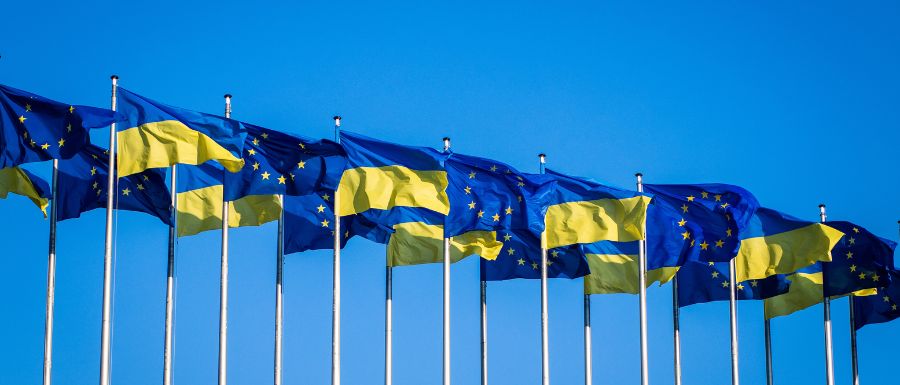
The formal opening of the “Fundamentals” negotiation cluster (Cluster 1) between the European Union and Ukraine on 15 June 2026 in Luxembourg marks a historic and irreversible milestone in Ukraine’s accession pathway. Convened under the Cyprus Presidency of the Council of the EU, this Intergovernmental Conference represents a major victory for enlargement policy, signifying that Ukraine’s extensive reform efforts have been recognised despite ongoing geopolitical crises.
While celebrating this achievement, ALDA highlights that the profound structural transformations required under Cluster 1 cannot be successfully achieved through top-down government mandates alone. A sustainable path to integration requires active ownership, institutional capacity building, and the systematic mobilisation of local governments and civil society organisations (CSOs) across Ukraine.
Under the EU’s revised 2020 accession methodology, Cluster 1 is the first to open and the last to close, effectively determining the overall pace of the entire negotiation process. This cluster encompasses the bedrock of European values, including the rule of law, democratic institutions and public administration reform. Resolving complex administrative and legal challenges under these chapters requires linking national policies in Kyiv to municipal realities on the ground. Without robust local institutions capable of executing these tasks, the transposition of the EU acquis will remain a theoretical exercise rather than a lived reality for Ukrainian citizens.
Specifically, aligning with the EU acquis across the cluster’s five chapters demands targeted subnational interventions. Implementing Chapter 5 (Public Procurement) and Chapter 32 (Financial Control) relies on building local capacity to prevent corruption in municipal reconstruction contracts and auditing EU assistance funds at the grassroots. Similarly, upholding Chapter 23 (Judiciary & Fundamental Rights) and Chapter 24 (Justice, Freedom & Security) is not possible without local mechanisms to protect minority rights, support internally displaced persons (IDPs) and veterans, and foster everyday democratic resilience. Finally, Chapter 18 (Statistics) necessitates training local administrations in standardised data collection to ensure evidence-based planning for regional recovery.
To bridge the gap between national legislative agendas and local execution, multi-level governance and the principle of subsidiarity must be operationalised. This imperative is anchored in ALDA’s robust and expanding network in Ukraine, comprising over 30 active member organisations, including regional councils, universities, civil society organisations and four major national associations of local authorities. Alongside the Ukrainian Association of District and Regional Councils, which recently became a full voting member, the network proudly includes the Association of Amalgamated Territorial Communities, the Vinnytsia Regional Association of Local Self-Government Bodies, and the All-Ukrainian Association of Communities. This powerful coalition ensures that a truly representative, bottom-up approach drives decentralisation reform and local recovery efforts. True public administration reform must occur at the grassroots, where civic councils, participatory budgeting, and transparent administrative service centres foster the democratic resilience needed to resist external disruption. Through its established Ukraine Task Force and Kyiv office, ALDA is uniquely positioned as a strategic operational partner to facilitate this decentralisation.
“The launch of the ‘Fundamentals’ cluster is a historic recognition of Ukraine’s reform achievements under extraordinary circumstances. However, the transposition of the European acquis is not just a bureaucratic exercise for central ministries. It is at the municipal and regional levels where the rule of law, anti-corruption and fundamental rights are experienced by citizens in their daily lives. For this integration to be sustainable, the EU and the Ukrainian government must ensure that local authorities and civil society organisations are fully empowered, adequately resourced, and systematically trained. ALDA is prepared to act as a primary operational partner in this multi-level governance effort.” — Antonella Valmorbida, Secretary General of ALDA.
Looking forward, ALDA remains committed to supporting its Ukrainian members and partners throughout the multi-year negotiation journey. By expanding its network of Local Democracy Agencies, we will continue to provide targeted training, foster decentralised cooperation and ensure that citizen engagement remains the cornerstone of Ukraine’s recovery and ultimate EU integration.