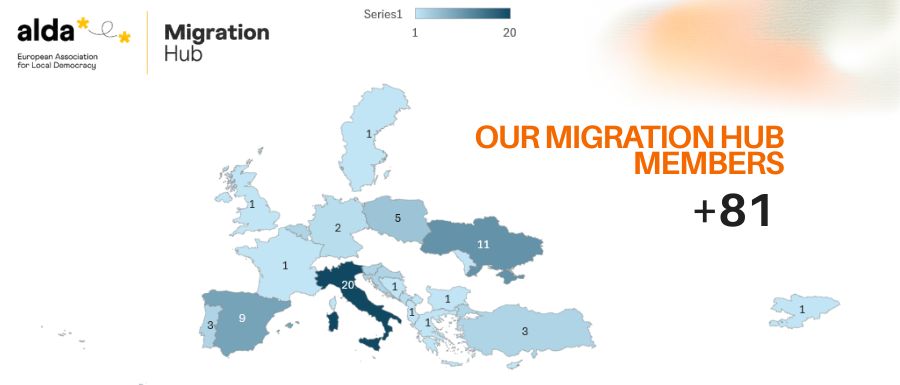
ALDA’s Migration hub recently convened a members’ consultation meeting to contribute to the development of its Migration Flagship 2026, bringing together local authorities, civil society organisations, and migrant-led initiatives from across Europe. Since 2024, ALDA has been structuring this process through annual consultations on key migration issues with its members, combined with the mapping of their expertise through targeted surveys. On this basis, ALDA updates its flagship strategy each year to reflect members’ priorities, respond to emerging European developments, connect EU-level policies with local realities, and integrate findings from EU-funded projects.
As part of this annual consultation process, ALDA Migration Hub and Maddalena Alberti (GB member and Migration Hub Chair) invited members to contribute their insights at a particularly crucial moment for EU migration and anti-racism policies. The consultation focused on the implications of the forthcoming EU Migration and Asylum Strategy 2026–2030 and the EU Anti-Racism Strategy 2026–2030, both expected to introduce significant policy shifts.
Discussions highlighted a growing tendency towards securitisation, digitalisation, migration diplomacy, and labour-market-oriented approaches, often at the expense of rights-based and inclusion-focused frameworks. Members stressed that anti-racism efforts remain largely non-binding and insufficiently connected to migration governance, while the implementation of the EU Pact on Migration and Asylum is already generating administrative uncertainty, reduced individual assessment in asylum procedures, and an increase in situations of legal limbo.
Across different national contexts, members also pointed to concrete challenges, including reduced funding for integration services, fragmentation of local coordination systems, and increasing pressure on municipalities tasked with border management. At the same time, examples of good practices—particularly in linking integration to housing, employment, and community-based initiatives—demonstrated the continued potential for inclusive local governance.
Participants emphasised that migrant people should not be treated merely as beneficiaries, but as active stakeholders in policy design and implementation.
In this regard, migrant-led networks were recognised as key actors in bridging information gaps, supporting civic participation, and countering miscommunication, particularly in sensitive areas such as return policies.
The consultation also raised important concerns regarding the expansion of digital border systems and the use of AI in migration management. Risks related to transparency issues and reduced human oversight were identified as critical areas requiring closer monitoring and advocacy.
Looking Ahead
ALDA will build on these insights to strengthen its role as a coalition platform, promoting local-based approaches, fostering multi-level cooperation, and supporting the meaningful inclusion of migrant-led organisations in governance processes.
👉 The outcome of this consultation will directly feed into ALDA’s Migration Flagship 2026 and ongoing EU advocacy work.work.