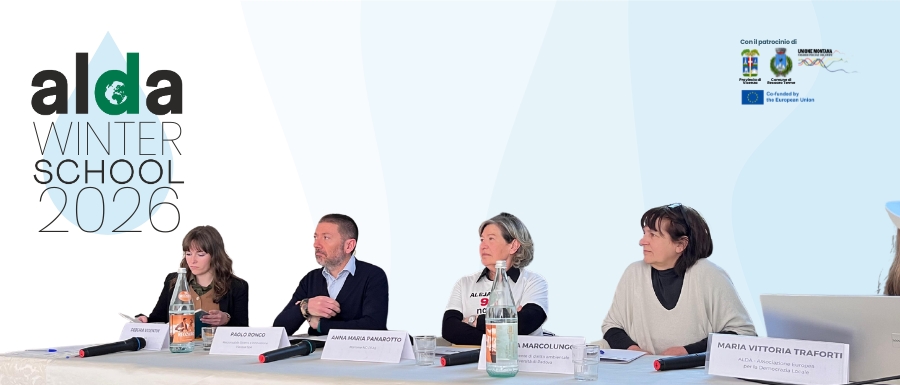
On March 27, ALDA Winter School 2026 took place at Hotel Trettenero in Recoaro Terme, bringing together local administrators, legal experts, civil society activists, and water management professionals for an afternoon of free, open training on one of the most pressing challenges of our time: water as a common good.
Under the title “Acqua come bene comune: democrazia locale e partecipazione dei cittadini per la tutela delle risorse idriche”, the event explored how local communities can move from environmental awareness to concrete collective action in the governance of water resources. The session was held under the patronage of the Comune di Recoaro Terme, the Provincia di Vicenza, and the Unione Montana Pasubio Piccole Dolomiti.
From awareness to action: a multi-stakeholder dialogue
The heart of the afternoon was the panel “Dalla consapevolezza all’azione: comunità e governance dell’acqua”, which brought together three speakers with complementary perspectives: legal, civic, and operational, creating a rich and grounded dialogue between territories, experts, and local communities.
Claudia Marcolungo, environmental law scholar at the University of Padova, opened the discussion by addressing the legal and institutional framework around water rights. She highlighted the complexity of overlapping regulatory layers – international, national, and European – and the challenges this creates for effective protection. Recognising water as a human right, she argued, requires both legal courage and cultural openness: a right that belongs to people regardless of citizenship or institutional recognition, but one that is still difficult to enforce within formal legal systems. Marcolungo also stressed the structural rigidities that affect environmental governance in Italy, where competences are shared across multiple levels, the state, regions, provinces, municipalities, and technical bodies such as river basin authorities, often leading to fragmentation. When it comes to EU directives, the risk lies not just in transposition gaps, but in losing sight of key principles during implementation. What is needed is clarity, resources, and the political courage to act.
Anna Maria Panarotto, representative of the Mamme NO PFAS movement, brought a very powerful testimony. The movement was born from five mothers determined to understand the contamination of their land by PFAS, highly persistent chemical compounds, and to protect not only their own children, but entire communities. Their story is one of civic persistence: studying the science, keeping public attention alive, and refusing to accept filtered water as a substitute for accountability. Panarotto described the indifference they still encounter as the greatest obstacle, alongside the difficulty of reaching national ministries and industry bodies. Yet she was equally clear about what makes civic engagement meaningful: the willingness to engage in calm, mature, non-violent dialogue: “it happened, and we want it never to happen again”. Participation has a cost, she acknowledged, but so does silence.
Paolo Ronco, Head of Research and Innovation at Viacqua SpA, provided a concrete picture of the water situation in the Vicenza-Veneto area. Despite abundant rainfall, the region is experiencing near-chronic water stress: aquifer levels have dropped significantly over recent decades, soil impermeabilisation prevents groundwater recharge, and the area ranks among the world’s highest per-capita water consumers, particularly in food production. Ronco introduced the Svolta Blu initiative, a governance and financing model designed to mobilise non-public resources for water efficiency through a local credit system that connects producers and buyers of environmental credits at the Vicenza-Veneto scale. The message was clear: public funding alone is insufficient, and new models of shared governance are essential.
The session also featured a presentation by Debora Visentin from Viacqua SpA on the Contratto di Fiume Retrone, a voluntary strategic planning instrument that integrates multiple territorial plans across governance levels. By bringing together institutional actors, technical bodies, and third-sector stakeholders, the River Contract aims to rebuild what was described as a “hydraulic society”, a community that is aware of its water resources and collectively committed to caring for its territory.
What truly made a difference on this occasion was the encounter between different perspectives and the mutual enrichment this brought to all parties involved, a testament to how networking is the very foundation of local democracy and participation in the common good.
Looking ahead: the launch of ALDA Winter School 2027
The closing session of the day marked an exciting moment for ALDA’s training programme: the official launch of the ALDA Winter School 2027. The announcement confirmed the continuation of this formative series dedicated to local democracy and civic participation, a flagship initiative that sits at the intersection of ALDA’s work on green and sustainable territories and its broader mission of promoting active citizenship across Europe.
🔗 Follow ALDA and join our network to know every opportunity.