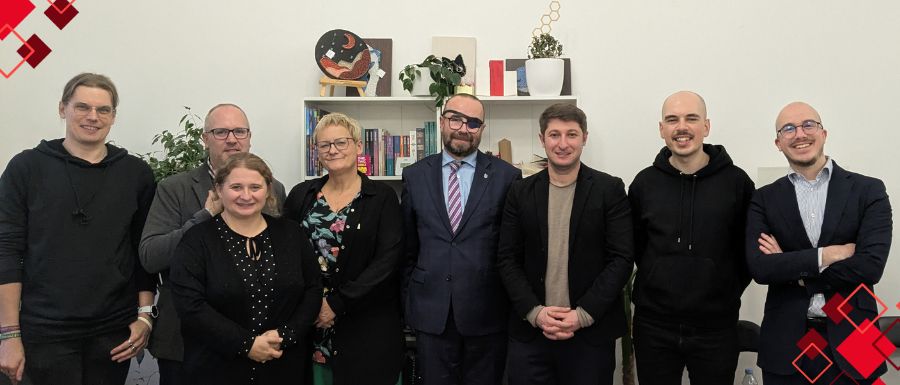
26 November 2025 – Kraków, Poland
Kraków has become one of the most significant centres for Belarusian exiles in Poland — a place where cultural identity, democratic engagement, and community resilience intersect. Building on earlier consultations held in Wrocław and Vilnius, ALDA — the European Association for Local Democracy — together with Prastora Krakow and the College of Eastern Europe (KEW), and with support from the German Marshall Fund, convened a dedicated dialogue on 26 November to deepen cooperation between Belarusian civic actors and local authorities. The meeting also served to advance the development of the emerging Local Democracy Agency (LDA) Belarus in Exile initiative.
As part of ALDA’s broader needs-assessment process, the Kraków meeting enabled exiled Belarusians to articulate their priorities and challenges while shaping the direction of the future LDA. This consultation reaffirmed what previous meetings had already indicated: that Belarusian civil society in exile is vibrant, motivated, and strongly committed to the preservation of Belarusian culture and its democratic engagement, yet faces significant structural challenges, including:
- Integration barriers, fuelled at times by misinformation, discrimination, and insufficient knowledge of available municipal programmes.
- Lack of dedicated community spaces for cultural, educational, and civic activities;
- Administrative and legal hurdles, including complex residence procedures, banking restrictions, and limited access to legal assistance;
Strengthening cooperation between exiled Belarusian communities and local institutions is essential to fostering inclusive governance and democratic resilience
Despite these challenges, participants emphasised strong cooperation with other migrant communities — particularly Ukrainian and Georgian — and expressed a strong desire to engage more actively in Kraków’s cultural and civic life.
When discussing the integration of migrant communities in Poland, invited migration and integration experts emphasised the need for clearer communication about available services, stronger anti-discrimination measures, and greater engagement from the “welcoming community” to ensure that integration is genuinely reciprocal.
In this context, it is worth highlighting the Open Kraków Programme, through which the city aims to foster long-term inclusion by improving access to services, strengthening intercultural dialogue, and creating spaces for community participation. Planned measures include enhanced staff training on administrative procedures and the creation of new dedicated spaces for social and cultural activities.
Additionally, as presented by Artur Buszek, a representative of the Mayor of Kraków, the city’s participatory tools — such as the citizens’ budget, citizens’ panels, and local civic initiatives — offer important opportunities for Belarusian residents to influence local decision-making and contribute meaningfully to public life.
Moving forward, the meeting confirmed both the necessity and strong local demand for the continuation of the LDA Belarus in Exile initiative. While its establishment will require time and continued coordination, the foundation is clear: the LDA should serve as a bridge between exiled Belarusian communities and local institutions, promoting inclusive governance, civic empowerment, and cross-border democratic engagement.
ALDA will continue facilitating these dialogues and working closely with Belarusian civic networks and local partners as the LDA Belarus in Exile takes shape — strengthening democratic resilience and fostering community-driven cooperation across borders.