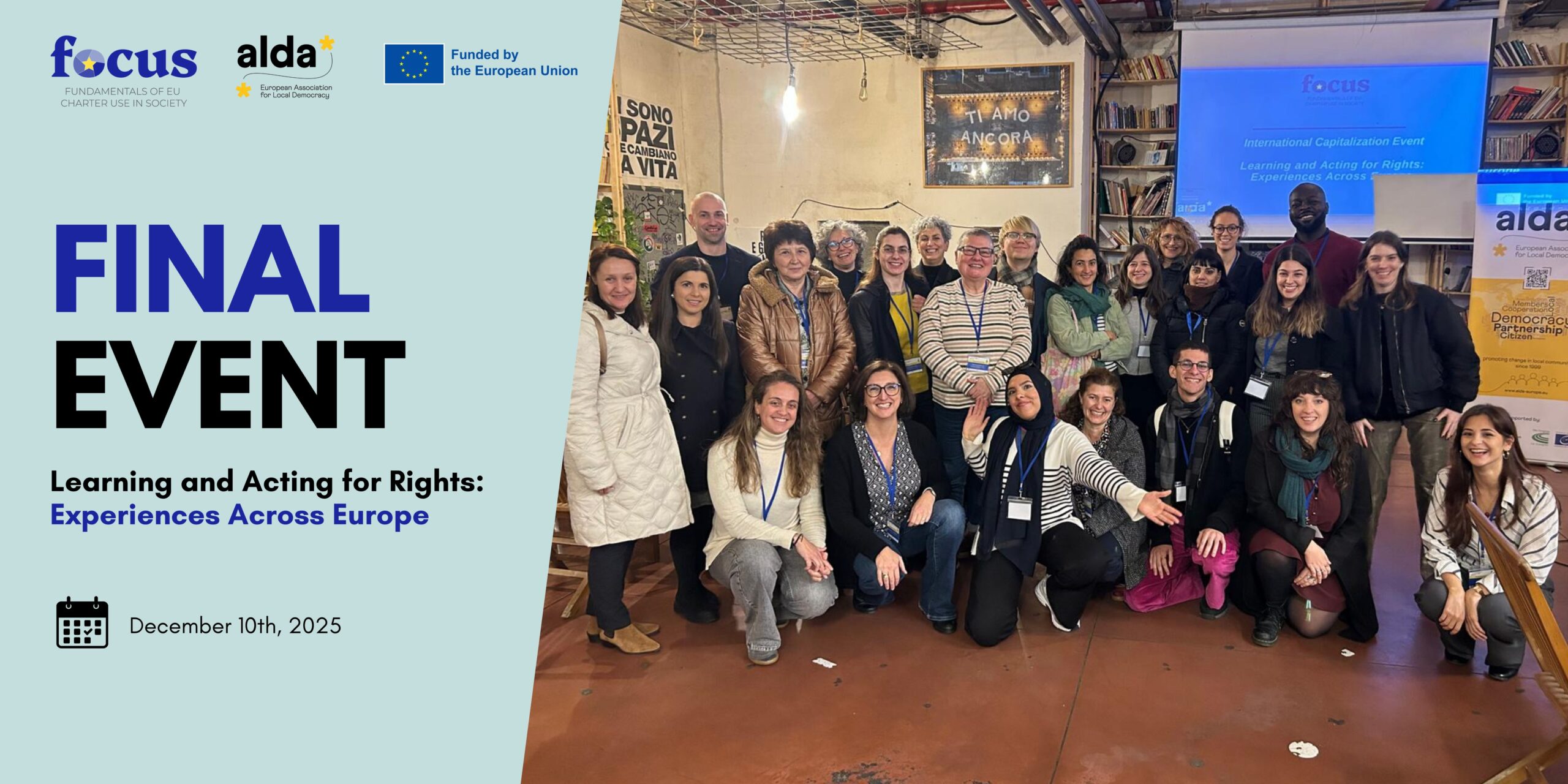
On 10 December 2025, on the occasion of Human Rights Day, ALDA hosted in Rome the FOCUS project final event dedicated to the EU Charter of Fundamental Rights. The event marked a key moment to reflect on how fundamental rights move from legal principles to concrete action, especially at local level, where institutions and communities work every day to make them real.
Over this year, FOCUS has worked to strengthen awareness and understanding of the EU Charter of Fundamental Rights across Europe. Journalists, experts, civil society organisations, local authorities, and young people have all been part of the journey, and many of these voices were brought together in one room to reflect on what has been achieved and, just as importantly, on what still needs to be done.
The event opened with a session dedicated to presenting the work carried out during the local trainings organised across Europe, giving participants an overview of how the EU Charter of Fundamental Rights had been explored and discussed on the ground. The members involved were the Municipality of Brescia in Italy, the Barcelona Provincial Council in Spain, the Human Rights Cities Network in Belgium, RAM Central Stara Planina in Bulgaria, and the Local Councils Association in Malta. Each had its own dedicated table, and participants moved around freely, sometimes leaning over tables to hear a story, other times scribbling notes or exchanging tips with a neighbour. This made every table a real space for exchange: participants shared their experiences, discussed challenges they encountered, and compared approaches to making the Charter more relevant in everyday decision-making.
The discussion then moved into two roundtable sessions, the first focused on Equality and Solidarity, two core pillars of the Charter. The goal was to bring these conversations beyond theory: participants worked on concrete policy recommendations, reflecting on how EU rights and values can be better translated into action on the ground. Attention was also given to the actors involved in policymaking at EU level, and to how local authorities, civil society, and citizens can have a stronger voice in these processes.
The second one focused on the everyday obstacles faced by local communities when trying to uphold fundamental rights. Around the tables, participants identified shared needs and recurring issues, from social inclusion and access to services, to environmental protection and participation in decision-making. These discussions highlighted how local realities can inform broader European debates, and why listening to them matters.
The EU Charter of Fundamental Rights truly becomes meaningful when it is translated into concrete action at local level, through the daily work of communities, institutions, and civil society
Closing the event and the project on Human Rights Day gave extra weight to these reflections. The conversations we had in Rome made clear that, while the EU Charter provides a strong legal and political framework, rights only become real when they are understood, claimed, and defended in daily life, and for this reason, local authorities and communities play a crucial role in this process, acting as a bridge between European values and citizens’ lived experiences.
The FOCUS final event did not feel like an ending, but rather a handover. The ideas, connections, and recommendations that emerged in Rome are meant to travel further, back to cities, regions, and organisations across Europe, becoming part of the broader and ongoing work of turning fundamental rights into practice.
A year of shared work showed that the EU Charter of Fundamental Rights truly comes to life when local authorities, civil society, and citizens work together to turn European values into concrete action.