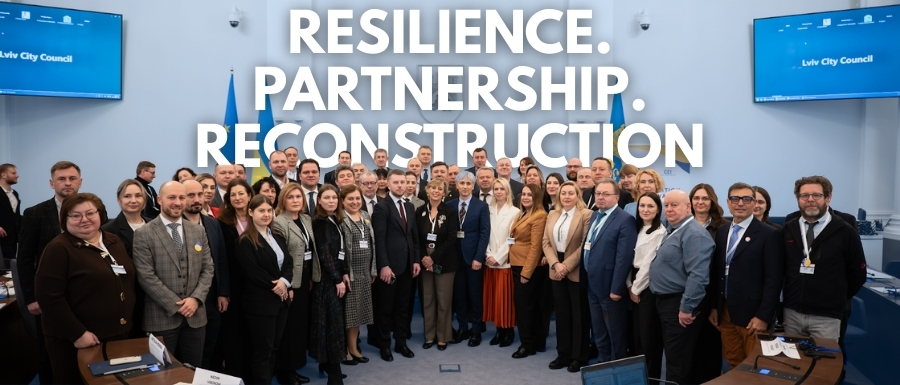
RESILIENCE. PARTNERSHIP.RECONSTRUCTION.
On 24 February 2026, four years had passed since the beginning of Russia’s full-scale invasion of Ukraine. Over this period, Ukraine has endured destruction, displacement and prolonged uncertainty. Yet across regions and municipalities, democratic governance has not collapsed. Local councils continue to meet. Civil servants continue to serve. Communities continue to organise. In parallel with military resistance, a quieter but equally decisive effort has continued: preserving democratic institutions and preparing for recovery.
For ALDA, support to Ukraine has meant sustained institutional engagement, structured cooperation and operational presence at local level. The year 2025 marked a significant consolidation of this commitment, reaffirming that local democracy remains central to Ukraine’s resilience and European integration.
Anchoring Recovery in the Local and Regional Dimension
In 2025, ALDA played a key role in preparing and coordinating the Local and Regional Dimension of the Ukraine Recovery Conference 2025 in Rome (Italy). In partnership with the Italian Ministry of Foreign Affairs, ALDA ensured that municipalities, regions and local democracy actors were fully integrated into international recovery planning.
This coordination was the result of a structured preparatory process. Major international gatherings in Brussels, Wrocław, Vicenza, Kyiv and Lviv created platforms for dialogue between Ukrainian local authorities, European municipalities and institutional partners. These exchanges strengthened partnerships and aligned priorities ahead of the Conference, embedding decentralisation and participatory governance within the broader reconstruction framework.
During URC 2025, discussions on reconstruction highlighted the role of local self-government in resilience, inclusive planning and long-term sustainability. Through its engagement, ALDA reinforced the recognition of local authorities as key actors in Ukraine’s recovery and EU accession pathway.
The work continued beyond Rome. On 26–27 November 2025, ALDA organised in Lviv the Post-Ukraine Recovery Conference Forum, “Capitalisation and the Way Forward: Decentralisation and Local Governance at the Centre of Ukraine’s Reconstruction.” The Forum translated political commitments into operational dialogue, shaping priorities towards URC 2026.
Reaffirming Political Commitment: Mission on the Fourth Anniversary
On the occasion of the fourth anniversary of the invasion, a mission to Ukraine led by ALDA’s Secretary General, Antonella Valmorbida, reaffirmed ALDA’s long-term commitment to local democracy, institutional resilience and multi-level governance.
At a critical stage marked by ongoing war, structured recovery planning and tangible progress towards EU accession, sustained political presence and structured dialogue remain essential. The mission strengthened engagement with Ukrainian local and regional authorities, national associations, civil society stakeholders and European institutional partners, ensuring that recovery efforts remain democratic and institutionally grounded.
Institutional Partnerships and European Coordination
Throughout 2025, ALDA intensified cooperation with European institutions and governments. It contributed to the Committee of the Regions’ Alliance for the Reconstruction of Ukraine and maintained structured coordination with the Italian Ministry of Foreign Affairs on matters concerning local and regional democracy.
Strategic cooperation with the U-LEAD with Europe programme expanded significantly. Preparations were finalised for a joint initiative supporting sixteen municipalities across eight Ukrainian regions in drafting or updating municipal charters aligned with the renewed legal framework on people’s participation. The initiative combined technical assistance with participatory mechanisms, including a dedicated component empowering emerging women leaders in local governance.
Collaboration with the Central European Initiative further promoted regional dialogue and knowledge exchange on decentralisation reforms and recovery challenges, ensuring that Ukrainian communities remained embedded within broader European cooperation frameworks.
From Policy Coordination to Concrete Support
ALDA combined advocacy with operational assistance throughout the war, mobilising over €134,000 in humanitarian aid for Dnipro, Odesa, Vinnytsia and Poltava. Assistance included emergency relief, shelter refurbishment, healthcare equipment, generators and psychosocial services for internally displaced persons and veterans, safeguarding essential services such as those at the Odesa Regional Children’s Hospital.
Youth exchanges and municipal partnerships continued through initiatives such as Bridges of Trust and the TIPS4UA internships in Barcelona (Spain), reinforcing EU–Ukraine peer exchange. Hate-speech prevention, participatory governance and green reconstruction were further advanced through the G.R.A.I.N. pilot and the ALDA Talks series on Green Reconstruction.
At the beginning of 2026, energy resilience re-emerged as a critical priority. On 13 February 2026, ALDA convened a Joint Coordination Meeting on Energy Needs and Support for Ukrainian Communities, gathering national associations of local authorities, municipalities, Local Democracy Agencies and European partners. A structured operational document detailing technical specifications and priority needs now guides coordinated equipment provision and financial support, ensuring that assistance reaches the most affected communities.
Local Democracy Agencies: Stories of Democratic Resilience
A cornerstone of ALDA’s presence in Ukraine is the development of Local Democracy Agencies (LDAs), locally based organisations supported through multilateral decentralised cooperation.
- LDA Mariupol focused on psychosocial recovery and youth empowerment, delivering hundreds of individual consultations and group sessions, and organising youth exchanges promoting civic participation.
- LDA Kharkiv Region inaugurated its office in the historic Derzhprom building, reinforcing institutional continuity in a region exposed to ongoing risks, while conducting evidence-based territorial analysis.
- LDA Dnipropetrovsk contributed to parliamentary work on Draft Law No. 6319 on self-organisation of the population, while facilitating bilateral municipal exchanges.
- LDA Vinnytsia, officially registered in 2025, rapidly positioned itself as an interlocutor on decentralisation and secured its first institutional grant from the Council of Europe.
- LDA Odesa was relaunched in December 2025, supporting communities with generators to ensure continuity of essential services.
- LDA Ovruch, established in 2025, initiated dialogue on energy transition in crisis contexts through international cooperation.
Together, these Agencies demonstrate that decentralisation in Ukraine remains active, adaptive and forward-looking.
ALDA Members in Action – 24 February 2026
On the fourth anniversary of Russia’s full-scale invasion of Ukraine, ALDA members and partners mobilised across Europe to commemorate the victims of the war, express solidarity with Ukrainian communities, and reaffirm their commitment to local democracy and recovery.
Commemoration and Solidarity at Local Level – Zhytomyr, Ukraine
In Zhytomyr, memorial ceremonies were organised to honour the victims of the war. The programme included thematic cultural, artistic, and educational initiatives dedicated to remembrance, resilience, and national unity.
All activities were conducted in line with national recommendations, ensuring a respectful and coherent narrative of commemoration while strengthening community cohesion.
Public Mobilisation in Brussels – Stand Up for Europe / Pulse of Europe
In Brussels, ALDA supported a public action organised by partners from Pulse of Europe Brussels. Citizens gathered in the streets to commemorate the victims of the war and to call for continued European action and sustained support for Ukraine.
Media Outreach and Storytelling – Women Who Inspire the World
ALDA contributed to the February edition of the monthly newsletter Women Who Inspire the World, dedicated to the fourth anniversary of the war.
The publication featured interviews with Antonella Valmorbida, Anastasiia Buslaieva, and Ukrainian activist Julia Singh, highlighting ALDA’s engagement, personal resilience, and the importance of maintaining international attention on Ukraine. Through storytelling, the initiative reinforced the human dimension of solidarity and democratic commitment.
Local Community Commemoration – Pula, Croatia
In Pula, a commemorative event brought together members of the Ukrainian community and local supporters.
A minute of silence was observed, followed by personal testimonies expressing solidarity and hope for a just and lasting peace. The gathering demonstrated the continued support of local communities across Europe for Ukraine and its people.
Institutional and Community Event – Vicenza, Italy
In Vicenza, an event was organised by CSV Vicenza in cooperation with the Municipality of Vicenza, with the collaboration of ALDA. The meeting included institutional speeches from the Mayor of Vicenza, representatives of CSV Vicenza, and ALDA’s Vice Secretary General.
The initiative highlighted the cooperation agreement signed in 2023, recognised the efforts made over the past four years to support displaced Ukrainians, and reaffirmed a shared commitment to solidarity, inclusion, and the pursuit of a just peace.
International awareness initiative – Exhibition in Gdańsk, Poland
Opening of the exhibition “Mariupol. The Path of Memory and Dreams”, dedicated to preserving the memory of the city and raising international awareness about its destruction and the experiences of its residents. The exhibition contributed to keeping the situation of Mariupol visible within the European public space.
Looking Ahead
Four years after the full-scale invasion, Ukraine’s resilience is visible not only in national decisions but in the continued functioning of municipalities, civic initiatives and local institutions.
Throughout 2025, ALDA combined international coordination, institutional partnership and operational support on the ground. By strengthening decentralisation, reinforcing participatory governance and expanding the LDA network, it has helped ensure that local democracy remains a cornerstone of Ukraine’s recovery and European integration.
On this fourth anniversary, we invite our members and partners to observe a minute of silence in remembrance of all victims of the war and in recognition of the resilience of Ukrainian communities.