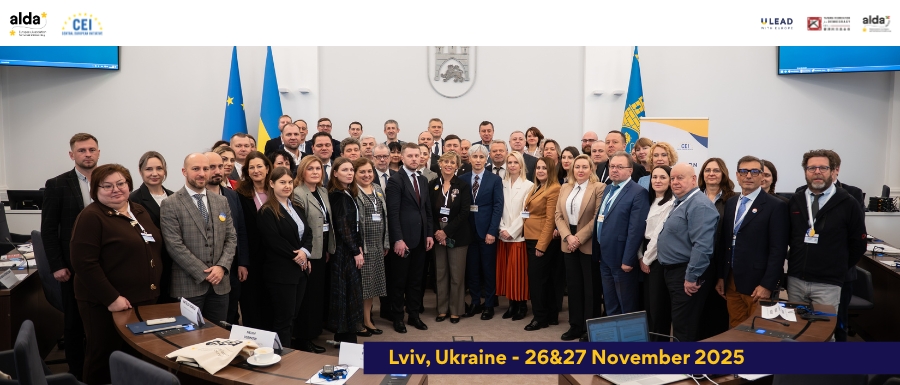
Post-Ukraine Recovery Conference 2025 Forum Takes Place in Lviv: “Capitalisation and the Way Forward: Decentralisation and Local Governance at the Centre of Ukraine’s Reconstruction”
We must ensure that all the good ideas of URC2025 do not remain merely empty conversations — this sentiment resonated throughout the plenary sessions of the Post-Ukraine Recovery Conference 2025 Forum, “Capitalisation and the Way Forward: Decentralisation and Local Governance at the Centre of Ukraine’s Reconstruction.”
It emerged as a guiding motto for the entire event, co-organised by ALDA and the Central European Initiative (CEI), with the support of U-LEAD with Europe and the Taiwan Foundation for Democracy, reflecting a shared commitment to turning dialogue into concrete action for Ukraine’s recovery.
The two-day event, held on 26–27 November in Lviv (Ukraine), combined several formats. High-level plenary sessions, governance laboratories, and a flexible networking platform created a truly dynamic space for cooperation.
Reflecting on the outcomes of the Ukraine Recovery Conference (URC2025) in Rome, participants at the Lviv Forum sought practical solutions to ensure Ukraine’s reconstruction is led by, and carried out in the interests of, local communities. This was also confirmed by Oleksii Riabikin, Deputy Minister for Communities and Territories Development of Ukraine.
“Every platform, including this one under the aegis of ALDA, envisages the signing of memoranda and new partnerships. This process is long-term and ongoing. It is important for our communities and regions to deepen cooperation with European municipalities and regions as much as possible. European integration also happens through such partnerships, through communication, and through the exchange of experience and knowledge. This is how we better understand how a modern, civilised Europe functions” – emphasised Deputy Minister Riabikin.
Oleksii Riabikin was among the speakers at the opening plenary, which took place inside a historical venue — the Lviv City Hall. The session gathered:
Yurii Mushka, Deputy Secretary General, Central European Initiative; Thibaut Guignard, Member of the European Committee of the Regions’ Working Group on Ukraine, Member of the ALDA Governing Board, Mayor of Ploeuc I’Hermitage & President of LEADER France; Tetiana Yehorova-Lutsenko, President of URAROR and Chair of the Kharkiv Regional Council; Andriy Moskalenko, First Deputy Mayor of Lviv; Vadym Boichenko, Mayor of Mariupol, ALDA Governing Board Member & Representative of the Association of Ukrainian Cities; Asier Santillán Luzuriaga, Head of Section – European Integration, Governance and Rule of Law, Civil Society, EU Delegation to Ukraine; Kessler Ryszard, Deputy Mayor of Wrocław (Poland); Mykhailina Skoryk-Shkarivska, Head of the Institute for Sustainable Community Development.
Across the remaining plenary sessions over the two-day Forum, many other distinguished speakers and experts joined the discussions, including: Fabrizio Rossi, Secretary General of CEMR; Natalia Hokina, Expert at the Association of Ukrainian Cities, responsible for international cooperation; Ljubica Kosheliuk, U-LEAD with Europe; Davide La Cecilia, Italian Special Envoy for the Reconstruction of Ukraine, URC2025 Coordinator; Tarschys Ingre Amelie, Congress of Local and Regional Authorities of the Council of Europe, Rapporteur on Ukraine’s Reconstruction; Christian Debève, Councillor of the Region Grand Est, President of the International Relations Commission, First Vice President of the Assembly of European Regions (ARE), Member of the Congress of Local and Regional Authorities of the Council of Europe. As well as dozens of other prominent European guests and representatives of Ukrainian local communities.
Some joined in person, others online — but what mattered most was that Lviv united them all.
Lviv as a hub for European initiatives
Hosting the Forum in the cultural capital of the Halychyna region was intended to strengthen direct cooperation between Ukrainian communities, European local authorities and to bring distinguished European guests closer to the representatives of Ukraine’s local democracies.
Lviv today is undoubtedly a major humanitarian and administrative hub. Andriy Moskalenko, First Deputy Mayor of Lviv, shared that the city currently hosts 1,050,000 residents, including 200,000 internally displaced people who fled the war.
“There are no borders between our cities today — we stand united as one strong Ukraine, defending not only Ukrainian values, but global and European values: the values of democracy,” — said Moskalenko.
Antonella Valmorbida, ALDA Secretary General and moderator of the opening session, invited the audience to observe a minute of silence in memory of those killed as a result of russian aggression, now a mandatory part of public events in Ukraine.
Reconstruction cannot wait
The war featured in every speech. Yurii Mushka, Deputy Secretary General of CEI, reminded participants that reconstruction efforts must not be postponed:
“This is already the eleventh year of Russian aggression, not four. Decentralisation accelerates and increases the effectiveness of reconstruction measures because more powers are held at the local level — meaning local self-government can respond more efficiently.”
Not for Ukraine, but with Ukraine
Speakers repeatedly stressed that the frontline is not just Ukraine’s problem, it is a matter of European security. What matters most is cooperation, listening to the concrete needs of communities, and working alongside them.
Maurizio Camin, Representative of the Trentino Council for the Balkans and ALDA Vice President, underlined the importance of local democratic initiatives:
“It would be very appropriate to develop cooperation between Ukrainian and Italian municipalities. It would also be extremely valuable to further expand our Local Democracy Agencies, which contribute greatly to this work. They are not only our antennas helping Europe understand what is happening, but also key actors of local development.”
Ukrainian regional representatives share this view. Tetiana Yehorova-Lutsenko, President of URAROR, stressed:
“I would insist that ALDA’s network in Ukraine must expand. Strengthening local self-government and decentralisation is, in my view, where true European democracy begins.”
European partners consistently emphasised: they do not work for Ukraine, but with Ukraine.
According to Antonella Valmorbida, effective cooperation rests on three pillars. Partnerships – establishing cooperation agreements between Ukrainian and international municipalities and communities. Joint projects – supporting Ukrainian communities in applying for and implementing grant-funded initiatives. People-to-people relations – fostering genuine long-term connections between individuals.
Looking ahead – road to URC2026
“Do you hear that sound? Right now, new partnerships and initiatives for the next URC are being prepared,” — joked Deputy Minister Oleksii Riabikin as he opened his speech. Anticipation of next year’s event — and the desire to make the most of the previous one — was a shared theme among speakers and participants.
“Before the next conference in July in Rome, it is vital to develop strategies for Ukraine’s future. Many ALDA representatives are here today, they support Ukraine and genuinely stand with it. This is our common path and our shared partnership,” — noted Antonella Valmorbida.
Beyond speeches and presentations, the Forum programme included two full days of group work.
Participants reviewed the effectiveness of URC2025 in Rome, identified its main outcomes, highlighted operational mechanisms already in place, and developed key questions for URC2026.
The result: a set of practical guidelines and priority issues for the next conference cycle.
This means the upcoming URC will be even more impactful, both for Ukraine and for a free Europe.